


What a Fire Damage Title Brand Means for Your Car
- What a Fire Damage Title Brand Means for Your Car
- What Is a "Fire Damage" Title Brand?
- How States Handle Fire Damage Branding
- What Happens to a Vehicle After a Fire
- Common Causes of Car Fires
- Insurance, Titles & Financing After Fire Damage
- Investigating Fire Damage
- Repair or Sell? What Makes Sense After Fire Damage
- FAQs About Fire Damage Title Brand
- FREE Vehicle Search
The average car owner or buyer may not think about vehicle titles, but ignoring this can have a financial impact and increase buying or selling hassles. Problems usually come to light as a title brand, an official notation on a state-issued title that warns about significant previous damage or an unusual history. Think of it as a car's report card, advising owners, buyers, lenders, and insurers about accidents, floods, theft, or fires. These, and other issues, can affect a car's value, safety, and drivability.
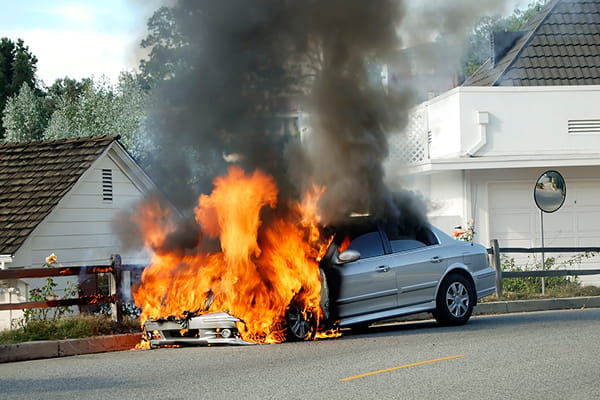
A Fire Damage Title Brand is one condition that deserves extra attention. Under these circumstances, a vehicle has been significantly affected by a fire. While this often occurs in the engine compartment, such damage can happen anywhere in or on the car. All it takes is a cigarette ash tossed carelessly in the cabin or a leaky fuel tank and a spark to set a vehicle ablaze. It's worth mentioning that a Fire Damage Title Brand involves much more than cosmetic issues; the destruction is significant enough for the insurer to declare the car a total loss.
For anyone who owns a vehicle involved in a fire, it's reasonable to ask, "My car caught on fire. What now?" At the same time, every automobile buyer should understand the implications of a fire-damaged title. Keep reading as we explain the details.
What Is a "Fire Damage" Title Brand?
The Fire Damage title designation usually applies when the cost of repairing the vehicle far exceeds the price of the labor and parts needed for a complete restoration. This calculation isn't arbitrary but usually involves fire repair costs exceeding a threshold based on a percentage of the car's market value. At this point, the insurer will declare the vehicle a total loss, and the state will assign a Fire Damage or equivalent title brand.
The brand will appear on the title document itself, with language like "Fire Damage" or "Salvage Fire". Once assigned, the title brand cannot be legally removed, it's permanent, even if repairs make the car drivable again.
This designation warns prospective purchasers that the vehicle has had significant damage. It's a critical advisory because undetectable issues could remain or arise later, even after car fire damage repairs. For instance, wiring or plastic components could be vulnerable. The same may apply to sensitive electronics or structural elements. Corrosion from water or extinguishing agents could take years to appear. Like all title brands, a Fire Damage notation informs future owners that the car has significant prior damage.
How States Handle Fire Damage Branding
Dealing with a Fire Damage Title Brand can get complex at the state level because each jurisdiction handles things differently. Most states don't issue a distinct fire-related designation. In these instances, severe fire damage falls under a generic salvage or non-repairable category, and the title would be branded accordingly with a "salvage" or "non-repairable" notation rather than Fire Damage. These states consider fire just one of many causes of a total loss.
However, some states will carry forward a Fire Damage brand included on a title issued by another state, such as when transferring titles between states. For example, Florida, Missouri, Texas, and Virginia explicitly state they recognize and preserve out-of-state or NMVTIS brands such as Fire Damage when issuing a new title.
Pennsylvania also participates in NMVTIS and preserves brand history across state lines. Still, it is not always clear whether the exact wording "Fire Damage" appears on the new title or is converted into Pennsylvania's own brand categories.
Note that state policies on title branding can change over time.
What is NMVTIS?
The National Motor Vehicle Title Information System (NMVTIS) is a federal database that tracks vehicle title, brand, and theft records nationwide to prevent fraud and protect consumers.
Some jurisdictions don't list Fire Damage as a distinct brand, but a vehicle titled there will typically carry forward a prior Fire Damage (or similar) brand from another state. These include the District of Columbia, Nevada, North Carolina, Ohio, Oregon, South Dakota, and Washington.
Meanwhile, a handful of states go further with explicit fire labels. Nebraska has Fire Damage on its official title brand list, while South Carolina uses the Salvage Fire label. Massachusetts takes a hybrid approach, treating fire as a sub-brand on salvage titles alongside designations such as flood, theft, or collision.
There's substantial value in explicit fire-damage title branding, which leaves no doubt about the vehicle's history. A less-specific salvage brand can obscure the actual cause of loss and complicate repairs and resale decisions. While not always a perfect fix, a vehicle identification number (VIN) history report can surface details that may be absent from a single state's title.
What Happens to a Vehicle After a Fire
Once the fire has been extinguished and the emergency ends, your steps with a car after a fire depend on insurance coverage and state rules. Contact your insurance company to file a report and submit a claim (if applicable). If the car is under a manufacturer's warranty, you may also want to reach out to the automaker or an authorized dealer if you suspect a defect caused the fire.
Here's a typical breakdown of what happens after a vehicle fire:
-
Assessment: If a claim is filed and you have appropriate coverage (comprehensive or collision), the insurance carrier will assess the damage. This may involve sending someone to inspect the car.
-
Loss Determination: The insurance company will assess the cost of repairs against the car's value. If the work to return the vehicle to a safe and drivable condition is too high, it will declare the car a total loss. In this situation, the process for issuing a Fire Damage Title Brand starts. In most states, a generic salvage title designation is used.
-
Title Branding: Upon receiving notice of the vehicle's status, the appropriate state motor vehicle agency will reissue the title under the Fire Damage or generic salvage classification.
-
Salvage vs. Rebuilt: Some vehicles with Fire Damage titles can be rebuilt and made drivable again, but the restoration process is complex. Much of this depends on state requirements, which may involve an extensive inspection before the car can be resold. However, such vehicles will still have a branded title. For example, South Carolina uses a Salvage Fire Rebuilt designation.
-
Parts or Scrap Outcome: Vehicles destroyed by fire and not rebuilt are often sold for parts or scrap metal value.
Common Causes of Car Fires
The best way to avoid a car fire is to prevent it in the first place. Be alert to potential trouble spots that include:
-
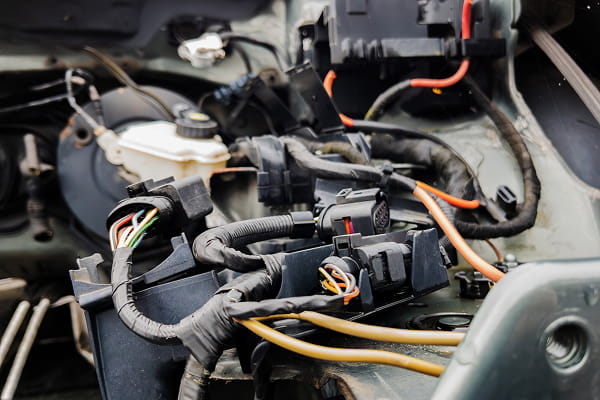
Electrical Malfunctions: Short circuits, frayed wiring, poor insulation, or improperly installed aftermarket electronics can trigger a fire.
-
Overheating: A blocked catalytic converter, engine component failure, cooling system malfunction (radiator, fan, hoses), or poor exhaust system flow may cause a fire.
-
Fuel Leaks: Fuel, oil, brake fluid, or power steering fluid dripping onto hot surfaces (like the exhaust manifold) can spark a fire. A fuel line or fuel tank leak is equally problematic.
Recalls That Raise Fire Risks
Recalls are common with modern automobiles, with the National Highway Traffic Safety Administration (NHTSA) reporting over 29 million vehicles affected in 2024. While every recall is important, some are more serious than others. In particular, several recent recalls highlighted the risk of vehicle fires. Examples include:
-
2020-2022 Ford Escape/2021-2024 Ford Bronco Sport: Over 300,000 Ford Escapes and Bronco Sports were recalled due to faulty fuel injectors that could leak and cause a fire. NHTSA Campaign: 25V467.
-
2010-2017 Kia/2010-2015 Hyundai (various models): Over three million Hyundai and Kia vehicles were recalled due to brake fluid leaks in the anti-lock brake system (ABS) that may cause an electrical short. NHTSA Campaign: 23V651000/23V652000.
-
2017-2022 Chevrolet Bolt: General Motors recalled over 140,000 Chevy Bolts due to a fire risk from the high-voltage battery pack. NHTSA Campaign: 21V560000.
Stay on top of recalls by periodically checking your vehicle's status on the NHTSA website. Instead of waiting on manufacturer notices, which can take months or might never arrive if you're not the original owner, you can use GoodCar's reliable and free recall lookup tool to quickly check your vehicle's safety status.
Preventing Future Car Fires
If you've already experienced a car fire, your vehicle may be at risk for a similar incident. Here's how to avoid a repeat of the situation:
-
Perform Expanded Maintenance: Add an extra layer of regular upkeep that includes inspecting the wiring harnesses, connectors, wiring insulation, and fuel lines.
-
Monitor Engine Temperature: Overheating can be a warning sign of a fire. Watch dashboard gauges and regularly maintain and inspect the cooling system.
-
Avoid Unsafe Aftermarket Modifications: Don't make any changes involving the powertrain, electric system, or wiring that a qualified technician doesn't perform. Any updates should meet safety and electrical load requirements.
-
Look for Leaks: Pay attention and immediately fix any leaks involving fuel, oil, or critical fluids (transmission, coolant, brake, or power steering).
-
Ensure Proper Exhaust System Operation: Check that the exhaust manifolds, catalytic converters, mufflers, and exhaust tubing are functional and free of obstructions.
-
Avoid Combustible Materials: Don't store fuel containers, aerosols, trash, and other flammable items in the car.
Insurance, Titles & Financing After Fire Damage
Once a severe vehicle fire happens, several ownership elements are impacted:
-
Insurance: For a vehicle to be covered for a fire-related loss, it must be protected by a comprehensive insurance policy. A collision policy would be necessary if the loss is due to an accident. Liability insurance doesn't pay for this type of damage. Once a claim is approved, the insurance company will either pay for repairs (minus any deductible) or declare the vehicle a total loss and pay out the vehicle's value. In the case of a total loss, the insurance company usually takes possession of the car and sells it through a salvage auction.
-
Title Branding: A total loss vehicle earns a Fire Damage Title Brand (or generic salvage designation) when the insurance company reports the incident to the relevant state motor vehicle agency. This status then becomes part of NMVTIS, which tracks branded titles.
-
Financing/Insurance Challenges: Should a vehicle with a Fire Damage Title Brand be repaired and pass any applicable state inspection, it can be retitled (usually under a rebuilt brand), registered, and driven on the street. However, the Fire Damage notation doesn't disappear. As a result, finding financing can be difficult, if not impossible. Insurance companies are also reluctant to cover a vehicle with a questionable history.
Investigating Fire Damage
While there's no substitute for a comprehensive inspection by a professional mechanic, there are several things you can do on your own. These preliminary steps are critical, whether you're checking over your car after a fire or assessing a used car for purchase.
#1: Start with Visible Signs
-
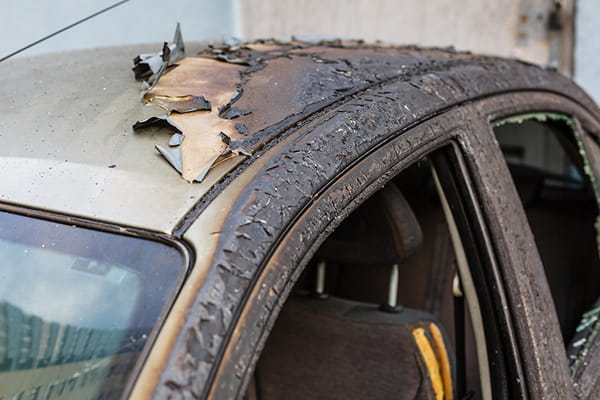
Burn Patterns/Soot Build-Up: Look for discoloration in the engine bay (especially underneath the hood), on wiring, in the cabin, or trunk.
-
Melt or Warped Components: Inspect underneath the dashboard, on wiring insulation, and on plastic surfaces (inside the engine bay).
-
Mismatched Wiring: Assess harnesses and other wiring for patched sections or cracked insulation.
-
Burnt or Smoke Odor: Be alert for any lingering aroma that can be difficult to eliminate.
-
Mismatched Paint or Fresh Parts in Odd Areas: Check for out-of-place repairs indicating patchwork remedies.
-
Corrosion: A build-up on fasteners, seams, or connectors can be caused by water or extinguishing chemicals.
#2: Assess Structural and Mechanical Issues
Telltale signs of a fire include weakened metal, warped panels, and failing welds. The heat can also damage sensors, airbags, and electronic control modules, which can be challenging to detect through a casual inspection. However, a more detailed review of these areas may require professional diagnostics.
#3: Back Up Findings with Documentation
Take a different approach to inspecting the vehicle by reviewing supporting records:
-
Fire Department or Insurance Reports: Track down official information to confirm details on the fire.
-
Repair Invoices or Logs: Assessing repair records can validate what's been fixed and what areas are untouched.
-
VIN History Report: Purchasing a vehicle history report can uncover a Fire Damage Title Brand or other unreported brand status.
#4: Put It All Together
Identifying fire damage involves looking for a pattern rather than a single clue. Burn marks, odd reports, and hints of corrosion may offer some insight. However, validating suspicions with records and a history report can provide a more complete picture and may prevent the need to hire a professional mechanic.
Repair or Sell? What Makes Sense After Fire Damage
As summarized below, whether repair makes sense depends on the severity, cost, and resale implications. This is based on the insurance company not being involved with your fire-damaged car.
When Repair Makes Sense |
When Repair Is Not Worth It |
|---|---|
Damage is limited to non-structural areas: smoke, upholstery, superficial wiring, or small dashboard parts. |
Vehicle requires substantial repairs involving structural components, engine, or major electrical/electronic controls. |
Estimated repair cost is less than the vehicle's value after repairs and with a branded title. |
The vehicle's post-repair value, which also reflects a branded title, is near or below repair costs. |
An experienced professional mechanic can complete repairs at a reasonable rate. |
Post-repair and branded title status make resale and obtaining insurance coverage difficult. |
Vehicle can pass required safety inspections and rebuilt-title requirements under state law. |
There is low market demand for this make and model with a fire damage repair history and a branded title. |
If you decide not to repair your fire-damaged car, a salvage yard or a rebuild specialist may be interested in purchasing the vehicle in its current condition.
FAQs About Fire Damage Title Brand
- What a Fire Damage Title Brand Means for Your Car
- What Is a "Fire Damage" Title Brand?
- How States Handle Fire Damage Branding
- What Happens to a Vehicle After a Fire
- Common Causes of Car Fires
- Insurance, Titles & Financing After Fire Damage
- Investigating Fire Damage
- Repair or Sell? What Makes Sense After Fire Damage
- FAQs About Fire Damage Title Brand
- FREE Vehicle Search
FREE Vehicle Search
- Accidents
- Problem Checks
- Title Records
- Recalls
- Values
- Specs


-
 InfoPay, Inc. (dba GoodCar) is an Approved NMVTIS Data Provider
-

-
