We are searching for
--
Please wait. This should take only a few seconds.

We are searching for
--
Please wait. This should take only a few seconds.

Sorry! We could not find the results.

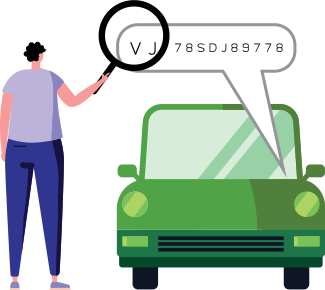
Nissan has become a popular automobile brand known for its reliability and affordability. It first started out as Datsun in 1931, but over the years, this Japanese carmaker has phased out the Datsun brand to stick with Nissan.
Today, each Nissan comes with a unique and global NHTSA (National Highway Traffic Safety Administration) 17-character code.
The Vehicle Identification Number (VIN) is a crucial piece of information for car owners, buyers, and mechanics. It contains specific details about the vehicle, such as the model, trim, engine, year, assembly plant, and more. Think of the VIN as your car’s DNA, and GoodCar’s VIN Decoder as the key to unlocking this vital information.
Looking up your car’s VIN is super simple with GoodCar’s decoder. Here’s what you’ll need to do:
That’s all you need to do to access your car’s identity with accuracy.
The VIN, regardless of the make and model, will be made up of a 17-digit Alphanumeric string of numbers and letters. All vehicles built from 1981 onwards are required to use this VIN format. This string of letters and numbers will contain specific information about the model, trim, engine, body style, plant, and build sequence, as well as:
Because Nissan builds so many vehicles and for different markets in major manufacturing facilities like Japan, the United States, and Mexico, no two cars will be alike. Decoding the VIN can help owners, mechanics, and buyers identify and verify specific models.
Your Nissan’s VIN is like the code that holds your car’s entire history. Think of running a VIN check like doing a background check on your car. GoodCar’s Nissan VIN Decoder can reveal huge amounts of information instantly and accurately. Decoding the VIN unlocks the following information:
Every VIN, whether it’s used on a Nissan or another brand, will follow the same globally accepted 17-character format. The VIN is broken down into three categories: the manufacturer identifier, the vehicle descriptor section, and the vehicle identifier section.
The first three digits of the VIN have one specific job: to reveal where the vehicle was made and what type of vehicle it is. These codes will vary by region and model year.
| WMI | Country/Region | Vehicle Type (typical) | Notes |
|---|---|---|---|
| JN1 | Japan | Passenger car | This common VIN code is used for Japanese-built Nissan vehicles for domestic and export markets. |
| JN8 | Japan | SUV / MPV | This VIN is used for Japanese-built Nissan SUVs and multipurpose vehicles. |
| 1N4 | United States | Passenger Car | This VIN is used on U.S.-built Nissan cars (Tennessee and Mississippi) |
| 3N1 | Mexico | Passenger car | This VIN is assigned to Nissan models that are built in Mexico for the Latin American and export markets. |
You can typically find your Nissan’s VIN in a number of different places on your car, like:
The easiest and most convenient place to look for the VIN is through the windshield to the dashboard.
Your Nissan’s VIN can do more than verify specs and where the car was built. You can sometimes use it to access the information from the original window sticker and factory build sheet. This will reveal what your car looked like when it was rolled off the assembly line, which includes:
Not all Nissan VINs will reveal this information, but when they do, this can be extremely useful for collectors and buyers who want to verify specific details.
As one of the most popular car brands in the world, there are so many different models, and while they might look alike on the outside, under the hood tells a very different story. Buyers, owners, and mechanics can run VIN searches to identify specific models. These are some popular Nissan models on which VIN checks are often used.
| Model | Class | Notable Notes (for VIN context) |
|---|---|---|
| Altima / Sentra / Maxima | Sedan | The Altima and Sentra are the carmaker’s most popular models, and the VIN is used to confirm details like the year, trim, and engine variant. For example, whether it’s a turbo or NA. |
| Rogue / Murano / Pathfinder | SUV / Crossover | Owners can use the VIN to decode the drivetrain (AWD or 2WD, the engine configuration, and the market specifications. |
| Titan / Frontier / Navara | Pickup / Utility | The VIN can be used to verify the chassis type, the engine, and the regional build. For example, the plant in Canton, Mississippi, specializes in trucks and sedans, whereas the Decherd plant specializes in engine and powertrain production. |
| Leaf / Ariya | Electric / EV | The VIN can be used to confirm the battery variant and EV build details. |
| 350Z / 370Z / GT-R | Sports | Nissan is owner of some iconic sports cars like the GT-R, and the VIN can be used to check the engine code and limited build edition. |
Your Nissan VIN can do a lot more than decode your car’s DNA, but it can also reveal safety and service information needed to maintain a long-term and dependable vehicle. GoodCar’s VIN Decoder has an option to choose the in-depth report on the recalls of a vehicle. A recall is a manufacturer-issued safety fix. The report will include recall notices that have the recall status, IDs, description, safety risk, and the next steps.
Why do you need this information? For owners and potential buyers, it’s about keeping your car in a drivable condition and being aware of potential problems down the line. For example, a recall search would reveal that the Japanese carmaker has recently recalled 173,301 vehicles in the United States due to a potential issue with blown fuel pump fuses. This problem can cause engine stalling. The October 2025 recall applies to these models: the 2013-2021 Nissan NV200 Van, 2014-2017, and the 2019 Nissan NV200 Taxi.
With GoodCar, you can also access the Technical Service Bulletins for advisories about common issues or recommended service updates. Having this kind of information can give buyers and owners peace of mind that they have the full picture of what’s really underneath the hood.
Why choose GoodCar’s Nissan VIN Decoder over others? GoodCar’s Decoder delivers instant and official results. All you need to do is input your VIN and get access to specific details, such as model, trim, engine, and plant data. You can take this search even further by using the optional in-depth reports on the recalls, accidents, and title brands.
By using GoodCar’s Decoder, you can avoid purchasing a car with costly fixes, incorrectly advertised details, and odometer scams. With this decoder, you have access to data on car values, trade-ins, and title brands. Researching a car’s title brand history is vital since some vehicles can have up to 50 separate title brands, including vandalism, junk, or rebuilt. You’ll want to avoid these!
GoodCar’s VIN Decoder can also make day-to-day tasks simple. For example, owners can use verified VIN data for filing insurance claims, and mechanics can use the VIN to verify the correct OEM parts needed. You can see why GoodCar’s VIN Decoder is the best choice for industry-leading data.