


"Agricultural Vehicle" Title Brand, Types, Uses, Rules, and Buyer Tips
- "Agricultural Vehicle" Title Brand, Types, Uses, Rules, and Buyer Tips
- What Is an "Agricultural Vehicle" Title Brand?
- Common Types of Agricultural Vehicles
- How a Vehicle Gets an "Agricultural" Title Brand
- How States Handle Agricultural Vehicles
- Who Assigns the Title Brand & Where It's Recorded?
- Impact of an "Agricultural Vehicle" Title Brand
- Can an "Agricultural Title" Brand Be Changed or Removed?
- Buyer & Seller Responsibilities
- Statistics & Market Data
- How to Check for Title Brands
- FAQs About Agricultural Vehicles and Farm-Use Registration
- FREE Vehicle Search
The term "title brand" may not come up in everyday conversations about automobiles, but every car shopper should be familiar with it. In simple terms, a title brand is a designation placed on a vehicle's title document detailing its usage and condition history. For those familiar with title brands, "Salvage" or "Rebuilt" is most likely to come to mind, but there are dozens of others, including the "Agricultural Vehicle" Title Brand. It identifies automobiles and motorized equipment primarily for farm or agricultural use.
An agricultural vehicle can range from a pickup truck hauling feed to a tractor or combine that never leaves the field. This distinction matters because these vehicles usually fall under different rules and requirements for registration, insurance, taxes, and road access. However, no state currently issues an Agricultural Vehicle Title Brand; agricultural status is handled through registration systems such as farm-use plates or exemptions.
Even so, it's still vital to be familiar with the agricultural vs. non-agricultural classification. We'll walk you through what the Agricultural Vehicle Title Brand refers to, how states classify agricultural use, and what buyers should know before purchasing a farm-use vehicle. We'll also explore how different states handle agricultural titles or registrations, what happens to resale value, and the importance of using a vehicle history report before purchasing a used car.
What Is an "Agricultural Vehicle" Title Brand?
An Agricultural Vehicle Title Brand indicates that the vehicle is intended primarily for farm or agricultural work, not everyday road use. The American Association of Motor Vehicle Administrators (AAMVA) lists Brand Code 26 (Agricultural Vehicle) in its national standard definitions, but this code isn't currently used by any U.S. state. It serves only as a reference for possible use in the National Motor Vehicle Title Information System (NMVTIS).
No U.S. state currently issues an official Agricultural Vehicle Title Brand. Agricultural status is only acknowledged through farm-use registration or plate systems, not on vehicle titles. In most states, similar restrictions appear as special plates or farm-use exemptions rather than title wording. The specifics are outlined later.
Common Types of Agricultural Vehicles
While just about any vehicle can be used for agricultural purposes, a Honda Accord or Chevrolet Camaro isn't practical for hauling hay or traversing muddy terrain. Additionally, ordinary cars aren't designed to work in the fields. As a result, there is a broad array of agricultural vehicles, including:
-
Farm Trucks: These vehicles are usually pickups or flatbeds that haul feed, seed, and equipment. Depending on the jurisdiction, use may be limited to private property or public roads with specific restrictions.
-
Tractors: Tractors handle plowing, tilling, and pulling heavy loads, so many states exempt these machines from titling or highway use requirements altogether.
-
Combine Harvesters: These specialized machines gather and separate grain crops. Most aren't registered for general road use as they rarely leave farm property.
-
Specialized Trailers: Designed to carry livestock, produce, or heavy implements. Some may qualify for reduced farm registration fees if they meet specific criteria.
-
ATVs and UTVs: These compact and versatile vehicles are often used for fence checks, irrigation maintenance, and access to rougher ground.
Depending on the state, each vehicle type may qualify for an agricultural classification. A truck registered for farm use in Texas might receive a standard title in Michigan. Meanwhile, a Vermont farmer may register equipment for farm use even if it never leaves private land, but that status does not appear as a title brand.
How a Vehicle Gets an "Agricultural" Title Brand
When registering a vehicle for farm or agricultural use, owners must show proof that the vehicle is used primarily for agricultural production or support work. Each state sets its own standards, typically requiring a farm tax-exemption number, USDA farm ID, or similar documentation. This verification applies only to registration; no state adds an Agricultural Vehicle Title Brand to the title.
Common qualifying standards include:
-
Primary operation on private property or within a set distance (often 25-150 miles) from the farm
-
Use for agricultural production, crop or livestock transport, or maintenance
-
Limited annual mileage or road use restrictions
-
Registration under a recognized farm-use exemption
One advantage of vehicles with official agricultural-use status is that many states exempt them from emissions testing and periodic inspections. This approach makes sense, as these vehicles spend little time on public roads. However, these benefits are limited, as states often restrict agricultural vehicles to short-distance hauling or local routes between farm properties.
How States Handle Agricultural Vehicles
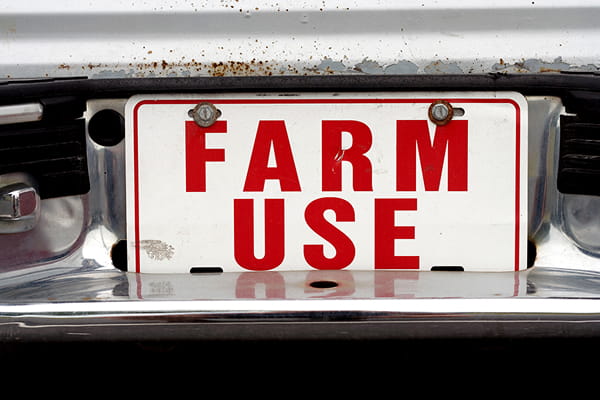
No state currently uses an Agricultural Vehicle Title Brand. Instead, farm and agricultural use is handled through registration systems such as farm-use plates, covered farm vehicle registrations, or implements of husbandry exemptions. Older records may include notes about agricultural use, but these appear only in registration files, not as printed title brands.
The table below lists some states that offer farm-use or agricultural registration options and shows how each jurisdiction handles these designations.
States with Agricultural or Farm Vehicle Registration (No Title Branding)
State |
Designation / Description |
|---|---|
California |
"Farm Vehicle" classification under the Vehicle Code; applies to registration, not title. |
Florida |
"Farm Truck" plate for vehicles transporting agricultural goods; no title branding. |
Indiana |
"Farm Vehicle" registration option for qualifying operators; not a title notation. |
Michigan |
Farm plates; many implements of husbandry are not titled. |
New Jersey |
"Farmer" / "Farm Use" plates for agricultural operation; no title brand. |
New York |
"Agricultural Class" and "Covered Farm Vehicle" registrations; no title branding. |
Ohio |
Farm-use vehicle registration required for agricultural hauling. |
Oregon |
Farm plates via registration; no agricultural title brand. |
Pennsylvania |
Four "Farm Vehicle" registration types (A-D); vehicles still titled conventionally. |
Texas |
Farm-use and implements-of-husbandry categories handled via registration; no title brand. |
Utah |
"Farm Vehicle" plates for agricultural transport only. |
Vermont |
Agricultural status handled through registration rules and exemptions; no title brand. |
Virginia |
"Farm Use" and "Unregistered Farm Use" pathways; registration-based, not title branding. |
Washington |
Farm exemptions/plates via registration; no agricultural title brand. |
Wisconsin |
Farm registration plates; brands printed on titles are damage/condition types, not agricultural use. |
Agricultural use is recorded through registration designations, such as Farm Vehicle, Covered Farm Vehicle, or Implements of Husbandry. These designations still affect road privileges, insurance, and taxes, so verify the rules in your state before purchase.
GoodCar Note: Although no state issues this brand, registration or prior-use remarks related to agricultural operation may still appear in NMVTIS data. Always review a comprehensive vehicle history report to confirm whether a vehicle's background includes agricultural use, farm registration, or any other special classification.
Who Assigns the Title Brand & Where It's Recorded?
Title brands and registration classifications are managed separately: states record damage or condition brands on titles, while agricultural use is handled through registration files and plate records.
These designations are also submitted to the National Motor Vehicle Title Information System (NMVTIS) for cataloging the state-supplied data. NMVTIS then approves providers like GoodCar to offer detailed vehicle histories that can highlight title brands and other vital details. NMVTIS ensures that title brands, like "Flood" or "Rebuilt", remain on record even if the car is retitled in another state.
Impact of an "Agricultural Vehicle" Title Brand
Value
While an Agricultural Vehicle Title Brand doesn't currently appear on any state-issued titles, vehicles registered for agricultural use are often viewed as special-purpose equipment. That classification usually reduces resale value outside the farm community because it limits how and where the vehicle can be used. In addition, trucks and SUVs that may be unsuitable for general public road use due to safety or other issues are sometimes given a second life as farm vehicles, further diminishing marketability and resale values.
Taxes and Fees
Recognizing that farm vehicles have focused functionality, many states lower costs through reduced registration fees or tax exemptions. For instance, Pennsylvania and Oregon allow discounted farm-use registrations. At the same time, Virginia offers a separate "Farm Use" and "Unregistered Farm Use" system that exempts qualified vehicles from annual registration if used only for agricultural purposes.
Insurance
Insurance for agricultural vehicles can be more complex than ordinary cars. In most states, registered vehicles must have insurance (usually at least basic liability and bodily injury coverage). However, with farm vehicles, the insurance company may want to know more about their use, such as on or off public roads. Some insurers issue policies under broader farm or agribusiness packages, which might exclude highway coverage unless you purchase a special endorsement. Many states also require unregistered agricultural vehicles to have insurance, which could fall under a general business liability policy.
Financing
Getting a traditional car loan for an agricultural vehicle may be more challenging as lenders seek to minimize risk. A vehicle registered for farm use has a smaller resale market, so a bank may require a larger down payment, shorter loan term, or a higher interest rate. You may have to work with a lender who is more comfortable with farm equipment.
If you plan to convert a farm-registered vehicle back to standard road use, check with your state DMV first. Before lenders treat it as conventional collateral, you may need an inspection, a plate change, and a tax reassessment.
Road Use Restrictions
Most states restrict where Agricultural Vehicles can legally travel. These limits keep slow-moving farm trucks and equipment off major highways. Restrictions can include a prohibition from any public road use or only crossing a public road while driving between properties.
In Virginia, vehicles with Farm Use or Unregistered Farm Use designations may operate only within 75 miles of the farm, cannot haul for hire, and must display identifying plates or placards. Similarly, New York's Covered Farm Vehicle rule restricts operation to 150 air miles from the farm base. Several other states have comparable distance or load restrictions.
Can an "Agricultural Title" Brand Be Changed or Removed?
Since no U.S. state currently issues an official Agricultural Vehicle Title Brand, this classification usually applies through registration, not the title itself. In states that record agricultural or farm use in registration systems, such as Virginia, Pennsylvania, or Texas, the status can often be changed if the vehicle is converted for everyday road use (which may require an inspection and re-registration).
To reclassify a vehicle from agricultural to standard use, the owner typically must:
-
Undergo a DMV inspection to confirm the vehicle meets safety and emissions requirements.
-
Pay any additional registration taxes or fees that apply to standard road vehicles.
-
Obtain new license plates and registration reflecting the updated classification.
Once those steps are complete, the vehicle is considered a standard passenger or commercial vehicle.
Buyer & Seller Responsibilities

Buying or selling a farm-registered or previously agricultural-use vehicle involves a few extra steps to ensure a smooth transaction for both parties.
Sellers
-
Disclose any existing farm-use registration, agricultural classification, and other known history conditions, such as title brands.
-
Provide supporting documentation such as farm-use certifications, exemption forms, and registration records. This may help the buyer register it as an agricultural vehicle.
-
Confirm that the buyer understands any road-use limitations or other restrictions tied to the vehicle's registration type.
Buyers
-
Verify that the vehicle's registration or title history and state regulations limit public road use.
-
Confirm that the vehicle's legal classification is suitable for the intended purposes, such as transporting goods.
-
Review maintenance and service records, as farm vehicles may endure heavier use. It may also be advisable to have a pre-purchase inspection by a mechanic experienced with farm-use vehicles.
-
Check the vehicle's history report to verify its status and background.
Statistics & Market Data
According to the U.S. Department of Agriculture (USDA) 2022 Census of Agriculture, there were 3,847,024 tractors in use on U.S. farms, along with 1,510,232 trucks and vans registered for agricultural work. Meanwhile, data from the Association of Equipment Manufacturers (AEM) shows that U.S. retail sales of farming tractors rated at 50 horsepower and above reached 103,217 units in 2023, up from 82,550 in 2015, a gain of more than 25% in large farm-machinery demand.
While these figures pale compared to the broader U.S. auto market, which sold more than 32 million new and used vehicles in 2024, they still reflect a healthy and active agricultural equipment sector.
How to Check for Title Brands
Before purchasing any farm-use vehicle, review its VIN history through an NMVTIS-approved provider. You can learn if there are any title brands, such as Fire Damage, Salvage, Rebuilt, Theft-Recovered, and Flood Damage. While it's unlikely that any agricultural notation will appear (because states record that only through registration), a VIN check still provides a complete title and use history.
Nonetheless, a VIN report will yield title history reported to NMVTIS, odometer data, sales history, and any state-to-state carryover brands. This information can help you get your money's worth with a farm-use vehicle.
FAQs About Agricultural Vehicles and Farm-Use Registration
This article provides an overview of the Agricultural Vehicle Title Brand. Title rules vary by state and can change over time, so always confirm current requirements with your state's motor vehicle agency before buying a vehicle with a branded title.
- "Agricultural Vehicle" Title Brand, Types, Uses, Rules, and Buyer Tips
- What Is an "Agricultural Vehicle" Title Brand?
- Common Types of Agricultural Vehicles
- How a Vehicle Gets an "Agricultural" Title Brand
- How States Handle Agricultural Vehicles
- Who Assigns the Title Brand & Where It's Recorded?
- Impact of an "Agricultural Vehicle" Title Brand
- Can an "Agricultural Title" Brand Be Changed or Removed?
- Buyer & Seller Responsibilities
- Statistics & Market Data
- How to Check for Title Brands
- FAQs About Agricultural Vehicles and Farm-Use Registration
- FREE Vehicle Search
FREE Vehicle Search
- Accidents
- Problem Checks
- Title Records
- Recalls
- Values
- Specs


-
 InfoPay, Inc. (dba GoodCar) is an Approved NMVTIS Data Provider
-

-
