



Car tuning covers a wide range of modifications, from a software recalibration that takes an afternoon to a full engine build that takes weeks and costs more than some used cars. What unites all of it is the goal of changing how a vehicle performs, handles, sounds, or responds beyond what the factory delivered.
For some drivers, tuning means extracting more horsepower from a turbocharged engine. For others, it means dialing in suspension geometry for track use, improving throttle response for daily driving, or simply making the exhaust note more satisfying. The appeal is real, and so are the trade-offs.
Tuning can improve a vehicle in meaningful ways, but it can also affect reliability, increase maintenance demands, raise insurance premiums, and create legal complications depending on what is modified and where you live. This article covers what car tuning actually does, the most common forms it takes, what it costs, and how to evaluate whether it makes sense for your situation.
What Is Car Tuning?
Car tuning is the process of modifying or recalibrating a vehicle's components to change how it performs, drives, or feels beyond the factory configuration. The term is broad enough to cover a $300 software adjustment to the engine control unit and a $15,000 forced-induction build. It includes mechanical changes, software changes, and often a combination of both.
The factory calibration of any production vehicle represents a compromise. Engineers balance performance against fuel economy, emissions compliance, noise regulations, warranty reliability targets, and the need to make one configuration work acceptably across a wide range of driving conditions and markets. Tuning is the process of unwinding some of those compromises in favor of the outcomes that matter most to a specific driver, in a specific vehicle, used in a specific way.
In the U.S. automotive enthusiast community, tuning most often refers to performance modifications, that is, increasing power output, improving handling, or enhancing driver feedback. In a broader sense, the term also encompasses suspension setup, brake upgrades, wheel and tire changes, and even aesthetic modifications. This article focuses primarily on the performance side, since that is where the functional trade-offs are most significant.

How Car Tuning Works
Modern vehicles are controlled by a network of electronic control units (ECUs) that manage fuel injection timing, transmission shift points, throttle mapping, and much more. The engine control unit is the most relevant for performance tuning. It processes inputs from dozens of sensors and uses calibrated tables to determine how the engine responds to throttle input, how much fuel to inject, when to fire the spark plugs, and how much boost pressure to allow in a turbocharged engine.
Software-based tuning modifies those calibration tables. A tuner with access to the ECU can advance ignition timing, increase fuel delivery targets, raise boost pressure limits, adjust throttle response curves, and remove or raise rev and speed limiters. The goal is to optimize engine behavior for the specific hardware installed and the way the vehicle will be driven.
Mechanical Tuning
Mechanical tuning works alongside software changes by physically improving how air, fuel, and exhaust move through the engine. A cold air intake routes denser air into the engine. A performance exhaust reduces backpressure, allowing spent gases to exit more efficiently. A larger turbocharger moves more air at higher boost levels. These hardware changes create the conditions for greater power, but they require corresponding software changes to safely take full advantage of the new hardware.
Suspension Tuning
Suspension tuning operates on different principles. It adjusts the geometry, stiffness, and ride height of the suspension to change how the vehicle handles cornering, braking, and acceleration. It does not affect engine output, but it can dramatically change the driving experience, particularly on track or on winding roads.
Why Tuning Works Best as a System
The most effective tuning is a system-level process, not a collection of independent parts. A cold air intake alone produces modest gains. An ECU tune alone on a stock engine produces modest gains. The same intake paired with a proper tune that accounts for the additional airflow, produces better results than either modification in isolation.
Common Types of Car Tuning
ECU and Engine Tuning
ECU tuning, also called remapping or chip tuning, is the most impactful single modification available for most modern vehicles. It involves reading the factory calibration data from the engine control unit, modifying the relevant parameters, and writing the new calibration back to the ECU.
On naturally aspirated engines, gains are typically modest, typically 5–15 horsepower, with a noticeable improvement in throttle response. On turbocharged engines, the results can be more substantial, with 20 to 80 or more horsepower possible depending on the engine and the supporting hardware.
ECU tuning can be delivered in several formats. Off-the-shelf tunes are pre-written calibrations developed by a tuner for a specific vehicle and modification combination. Custom tunes are developed on a dynamometer with the specific vehicle, allowing the tuner to optimize for the actual hardware installed and the actual fuel being used.
Custom tunes are more expensive but generally produce better results and carry less risk. Remote tuning, where the driver sends data logs to a tuner who writes and emails back a revised calibration, has become increasingly common for popular platforms.
Some vehicles, particularly in the German luxury segment, come from the factory with significant power held in reserve by the ECU calibration for market positioning or engineering margin reasons. A tune on these vehicles can unlock that headroom with relatively low risk.
Other vehicles are tuned close to the limits of their components from the factory, and a tune pushing beyond that point requires hardware upgrades to support it safely.
Intake and Exhaust Upgrades
The engine is an air pump. The more air it can draw in, and the more efficiently it can push spent gases out, the more fuel it can burn and the more power it can produce. Cold air intakes replace the factory air box with a system that draws cooler, denser air from outside the engine bay. Cooler air contains more oxygen per unit volume, which supports more complete combustion.
Most cold air intakes also reduce intake restriction compared to the factory paper filter element, allowing air to move more freely. Power gains from a cold air intake alone are typically modest, in the 5–15 horsepower range, but the improvement in intake sound and throttle response is often noticeable.
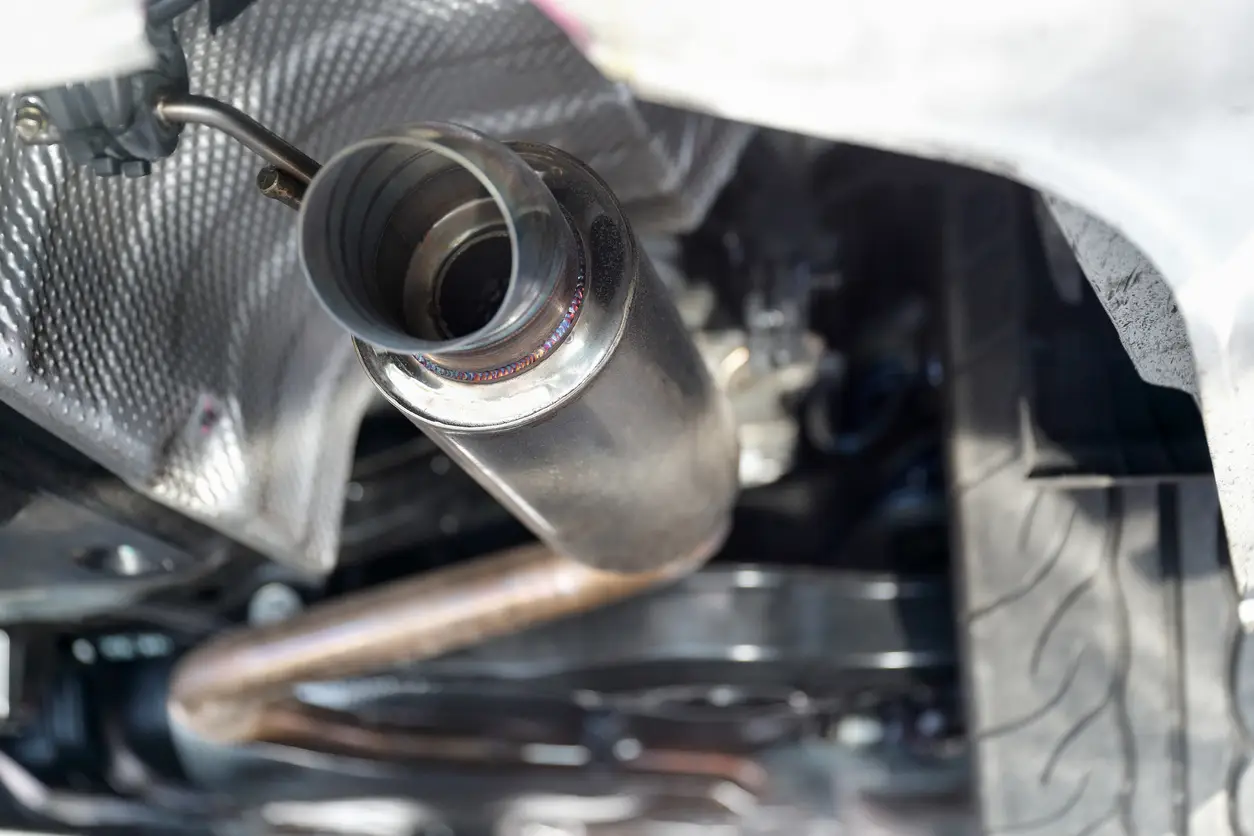
Performance exhaust systems reduce the backpressure that factory exhaust systems impose to control noise and meet sound regulations. Cat-back exhaust systems replace everything from the catalytic converter back, including the muffler and tailpipe. Axle-back systems replace only the rear section.
Header-back or turbo-back systems are more comprehensive and replace most of the exhaust path from the engine. More extensive systems produce larger power gains but also more noise, and systems that remove or replace catalytic converters create emissions compliance issues in most states.
Suspension and Handling Tuning
Suspension tuning changes how a vehicle handles rather than how much power it produces. The most common modification is a lowering spring or coilover kit that reduces ride height, lowers the center of gravity, and typically increases spring stiffness.
A lower center of gravity reduces body roll in corners, improving handling response and feel. Stiffer springs limit suspension movement, reducing weight transfer and improving cornering consistency, but they can make the ride less comfortable on rough roads.
More advanced suspension tuning includes sway bar upgrades that reduce body roll independently of spring stiffness, alignment changes that adjust camber and toe angles for more aggressive corner contact, and upgraded bushings that reduce compliance in the suspension geometry.
Track-focused builds often use coilovers with adjustable damping that can be tuned for different surface conditions. Street builds have to balance handling improvement against daily-use livability, since the stiffer setups optimized for track use can be fatiguing on normal roads.
Turbocharger and Supercharger Upgrades
Forced induction upgrades represent the higher end of the performance tuning spectrum in terms of both power potential and cost. A larger turbocharger moves more air at higher boost pressure, which supports more fuel and produces more power.
A supercharger adds forced induction to a naturally aspirated engine that did not have it from the factory, using a belt-driven compressor to pressurize the intake charge.
These modifications produce the largest power gains available short of full engine rebuilds, often adding 50 to 200 or more horsepower depending on the platform. They also require the most supporting work.
Upgraded fuel injectors, a higher-capacity fuel pump, an intercooler, and reinforced engine internals may all be necessary depending on the power target and the stock components' ability to handle the additional stress. A quality ECU tune calibrated for the new hardware is not optional; it is a prerequisite for safe operation.
Cosmetic and Styling Modifications
Some drivers use the word tuning broadly to include visual changes: body kits, spoilers, wheels, interior modifications, and custom paint. These changes affect appearance and, in some cases, aerodynamics, but they do not directly change engine output, handling dynamics, or driving performance in the way performance modifications do.
Aerodynamic additions like front splitters and rear wings can provide meaningful downforce at track speeds but are largely cosmetic at street speeds. This article uses tuning in the performance sense, but it is worth acknowledging that many enthusiasts pursue both simultaneously.
What Car Tuning Can Improve
The following are the most commonly realized improvements from tuning, stated practically rather than optimistically.
- Power output. ECU tuning and hardware upgrades can increase horsepower and torque. On a turbocharged engine with room in the calibration, gains of 20–40% over stock are achievable with a quality tune and supporting modifications. On a naturally aspirated engine tuned close to its limits from the factory, realistic gains are more modest, typically in the 5–15% range.
- Throttle response. Factory throttle maps are often calibrated to feel smooth and linear rather than immediate. A tune can sharpen the throttle response, making the engine feel more reactive to pedal input. This does not necessarily change peak power but changes how the power is delivered, which affects how the car feels to drive.
- Torque delivery and power band. A well-written tune can improve the shape of the torque curve, delivering more torque at lower RPM for better in-gear acceleration, or broadening the peak power band so the engine pulls stronger over a wider range. This is particularly valuable on turbocharged engines, where factory calibrations often limit low-RPM torque to protect the drivetrain.
- Handling and cornering balance. Suspension tuning can meaningfully improve how a vehicle handles corners, reduces body roll, and responds to driver inputs. For drivers who use their vehicles on track or on winding roads, a well-set-up suspension can transform the driving experience in ways that horsepower alone cannot.
- Fuel economy (in some cases). A tune optimized for efficiency rather than power can improve fuel economy by improving combustion efficiency and reducing the conservative fuel delivery margins built into factory calibrations. This is more commonly the goal in diesel tuning than in gasoline performance tuning, but it is a legitimate application.
How Car Tuning Can Affect Reliability and Maintenance
More power means more stress. That is the central reliability trade-off in performance tuning, and it applies to almost every component in the powertrain.
A turbocharged engine producing 350 horsepower from a factory-rated 280-horsepower base is generating more heat, more cylinder pressure, and more mechanical stress on bearings, pistons, connecting rods, and the turbocharger itself than it was designed for. Whether that additional stress falls within safe margins depends on the quality of the tune, the condition of the supporting hardware, and how the vehicle is driven.
A conservative tune on a well-maintained engine with quality supporting parts can operate reliably for high mileage. An aggressive tune on a high-mileage engine with marginal cooling can accelerate component failure.
The transmission is often the first component to show wear under tuned power levels, particularly automatic transmissions that were not designed to handle the additional torque. Clutches on manual transmissions wear faster when subjected to aggressive launches and high torque levels. Differential and driveshaft components are similarly affected on high-power builds.
Maintenance intervals become more important after tuning, not less. Engine oil needs to be changed more frequently because the oil is working harder. Coolant condition and cooling system capacity matter more when the engine is producing more heat. Spark plugs may need to be replaced at shorter intervals.
Tuned vehicles generally require higher-octane fuel, and using fuel below the tune's requirements can cause knock events that damage engine components.
The most common reliability failures on tuned vehicles are not failures of the tuned system itself but failures of components that were not upgraded to match the new power level. A transmission failure on a tuned vehicle is often not a tuning problem; it is a build planning problem that should have included a transmission upgrade.

Downsides of Car Tuning
Tuning improves a vehicle in specific, measurable ways, but every performance gain comes with a corresponding trade-off that is worth understanding before committing to a build.
- Increased wear on powertrain components. Higher power levels mean more stress on the engine, transmission, differentials, and drivetrain. Components that were adequately sized for stock power may be marginal at tuned power levels. This affects service life and increases the likelihood of component failure, particularly if the rest of the drivetrain is not upgraded to match.
- Higher fuel requirements. Most performance tunes require premium or high-octane fuel to operate safely. If a tune is written for 93-octane fuel but the vehicle is filled with 87, the ECU will pull ignition timing to prevent knock. The ongoing cost of premium fuel adds up over time.
- Reduced fuel economy at higher performance levels. An aggressive tune optimized for maximum power typically worsens fuel economy compared to the stock calibration, because it uses more fuel to support higher output. The real-world fuel economy impact depends heavily on how the vehicle is driven after tuning.
- Rougher ride quality. Suspension upgrades that improve handling almost always involve stiffer springs and dampers, which transmit more road surface to the cabin. A coilover setup that works brilliantly on a smooth track surface can feel punishing on a potholed urban road. This is one of the clearest daily-use trade-offs in performance tuning.
- Increased noise. Performance exhausts are louder than stock systems. Cold air intakes can amplify intake noise at higher RPMs. Some drivers enjoy these sounds; others find them tiring over a long commute. Local noise ordinances in some jurisdictions also create legal exposure for vehicles with significantly modified exhaust systems.
- Poor-quality tuning can make things worse. Not all tunes are created equal. An off-the-shelf tune written for a different fuel quality, a different climate, or a slightly different hardware configuration can cause knock events, poor idle quality, or drivability problems.
A tuner who does not properly validate their calibration on a dynamometer can create reliability problems that did not exist before the modification. Choosing a reputable tuner with documented experience on the specific platform is not optional.
The table below summarizes typical costs and power gains for common modification types.
|
Modification Type |
Typical Cost |
Potential Power Gain |
Key Considerations |
|
ECU tune / remap (naturally aspirated) |
$300-$700 |
5-15 hp |
Quality of tune matters; dyno verification is recommended |
|
ECU tune (turbocharged) |
$500-$1,200 |
20-80+ hp |
Supporting mods are often required for large gains |
|
Cold air intake |
$150-$400 |
5-15 hp |
Often paired with a tune for best results |
|
Performance exhaust system |
$400-$2,000+ |
5-20 hp |
Emissions compliance varies by state |
|
Coilover suspension kit |
$800-$3,000+ |
N/A |
Ride comfort trade-off; alignment required after install |
|
Turbocharger upgrade |
$2,000-$6,000+ |
50-200+ hp |
Requires supporting mods; tune mandatory |
|
Supercharger kit |
$3,000-$8,000+ |
50-150+ hp |
Engine internals may need reinforcement at high boost |
Note: Costs and power gains are approximate and vary significantly by vehicle platform, tuner, region, and specific hardware used.
Does Car Tuning Void Your Warranty?
Not automatically, but it can affect coverage for related repairs.
In the United States, the Magnuson-Moss Warranty Act of 1975 governs aftermarket modifications and warranty coverage. Under this law, a manufacturer cannot void an entire vehicle warranty simply because aftermarket parts have been installed. To deny a warranty claim on a modified vehicle, the manufacturer must demonstrate that the aftermarket modification caused or contributed to the specific failure being claimed.
In practice, this means that an ECU tune on your engine does not automatically void the warranty on your air conditioning system or your infotainment unit. However, if you have an ECU tune and your engine suffers a connecting rod failure, the manufacturer has strong grounds to deny the engine warranty claim by arguing that the tune increased cylinder pressure beyond the engine's design limits. The more directly a modification relates to a failed component, the more likely the claim will be denied.
Dealerships vary in how aggressively they investigate modifications when processing warranty claims. Some dealerships will deny claims upon seeing any modification. Others focus only on modifications that are directly related to the failure. It is worth noting that modern ECUs log data, including maximum RPM, maximum boost pressure, and, in some cases, whether the calibration has been modified. This data is often visible to dealership service departments during diagnosis.
Some tuning solutions offer a "return to stock" function that rewrites the original factory calibration back to the ECU before a dealer visit. Whether this fully eliminates the risk of a denied warranty claim depends on the specific ECU and the dealership's diagnostic tools, since some ECUs log tune history that persists through calibration changes.
Does Car Tuning Affect Insurance?
Yes, in ways that vary by insurer, by modification type, and by state. The key issue is disclosure. Most standard auto insurance policies in the U.S. are written for the vehicle as it was originally manufactured. Significant modifications that change the vehicle's value or risk profile are often required to be disclosed to the insurer.
Performance modifications that increase power output, lower ride height, or change the vehicle's handling characteristics can increase the actuarial risk associated with the vehicle. Some insurers respond by increasing premiums. Others may decline to renew coverage or add exclusions for claims related to the modifications. An insurer who was not informed of modifications and later discovers them during a claim investigation may have grounds to deny the claim or cancel the policy.
Specialty insurance providers that focus on modified and collector vehicles, such as Hagerty or American Collectors Insurance, often provide better coverage terms for modified vehicles than standard carriers, because they underwrite the vehicle's actual modified configuration rather than its stock value and specification.
The most straightforward advice is to disclose significant modifications to your insurer and ask specifically how they affect your coverage and premium. If the answer is unsatisfactory, shop for a carrier that specializes in modified vehicles. Driving a significantly modified vehicle on a standard policy that excludes modifications is a meaningful financial risk.
Is Car Tuning Worth It?
The honest answer depends entirely on what you are trying to achieve, how you use the vehicle, and what you are willing to manage as a result.
Tuning makes the most sense when the vehicle is already paid off or low-cost, the driver has specific performance goals that factory equipment does not meet, the vehicle will be used in ways where the improvements are actually felt, the driver understands and accepts the trade-offs in reliability, maintenance, and cost, and the modifications are legal for the intended use.
A track-day enthusiast who takes a dedicated track car to a circuit on weekends has a clear use case for aggressive suspension and power tuning. The trade-offs in ride comfort and maintenance are acceptable because the vehicle serves a specific purpose.
A driver who wants to extract more fun from a turbocharged daily driver with a modest ECU tune and a cold air intake is making a reasonable and manageable modification. A driver who wants to double the power of a stock engine and still use the vehicle as a daily driver for 30,000 miles a year will need to be prepared for the maintenance demands and reliability risk that come with it.
The modifications that tend to deliver the best return on the experience investment are conservative ECU tunes on turbocharged platforms with room in the factory calibration, suspension upgrades on vehicles used on winding roads or tracks, and combined intake and exhaust upgrades paired with a proper tune.
The modifications with the worst return on investment tend to be aggressive power builds on vehicles not designed to handle the stress, off-the-shelf tunes that are not validated for the specific vehicle, and cosmetic modifications sold as performance upgrades.
FAQs About Car Tuning
Does tuning make a car faster?
It depends on the type of tuning and the vehicle. ECU tuning on a turbocharged engine with margin in the factory calibration can meaningfully increase horsepower and torque, which translates to faster acceleration. Suspension tuning does not add power but can improve lap times on a track by improving handling balance, reducing body roll, and allowing the driver to carry more speed through corners.
The combination of power and handling improvements produces the most significant change in overall performance. On a naturally aspirated engine already tuned close to its limits, the gains from an ECU tune are more modest.
Is ECU tuning safe?
A quality ECU tune from an experienced tuner with a verified track record on the specific vehicle platform is generally safe when the supporting hardware is in good condition and appropriate for the power level being targeted.
An off-the-shelf tune from an unknown source, a tune that has not been validated on a dynamometer, or a tune that exceeds the mechanical limits of stock components carries significant risk. The quality of the tuner matters as much as the hardware's quality. Asking for dyno sheets, referrals from other owners of the same vehicle, and a clear explanation of what the tune changes are reasonable due-diligence steps.
Can tuning hurt engine life?
Yes, if the tune pushes beyond what the engine's components can reliably handle, or if the vehicle is not maintained appropriately for its modified state. Higher cylinder pressure, more heat, and more mechanical stress all accelerate component wear. A conservative tune on a well-maintained engine with proper supporting hardware can operate for high mileage without significantly shortening engine life.
An aggressive tune on a high-mileage engine with worn bearings, marginal cooling, or inadequate fuel quality can cause failures that would not have occurred on the same engine in stock form. Maintenance discipline matters more on a tuned vehicle than on a stock one.
Is car tuning legal in all states?
Not all modifications are legal in all states. The largest area of legal complexity is emissions compliance. The EPA and California Air Resources Board (CARB) prohibit the use of aftermarket components that remove or defeat emissions control devices, including catalytic converters and evaporative emissions systems. California has its own stricter standards, and parts sold for use in California must carry a CARB Executive Order (EO) number confirming compliance.
Many other states have adopted California's standards or perform their own emissions inspections. ECU tunes that remove emissions-related functionality or delete error codes are illegal for use on public roads in most states. Track-only vehicles are subject to different rules. Before modifying any emissions-related system, checking the specific regulations for your state is the necessary first step.
Is Car Tuning Legal?
Most performance modifications are legal for street use, but the line is drawn at emissions and safety systems. Under federal law, it is illegal to tamper with or defeat emissions control equipment on a vehicle registered for public road use. This covers catalytic converter removal, EGR delete, DPF delete on diesel vehicles, and ECU tunes that disable oxygen sensor monitoring or emissions-related fault codes.
Modifications that do not affect emissions systems, such as ECU tunes that increase power within the factory hardware limits, intake systems with appropriate emissions certifications, and suspension upgrades, are generally legal.
Noise regulations vary by jurisdiction and can create exposure for vehicles with significantly louder exhaust systems than stock. When in doubt, verify that specific parts meet the required certifications for your state before purchasing.