


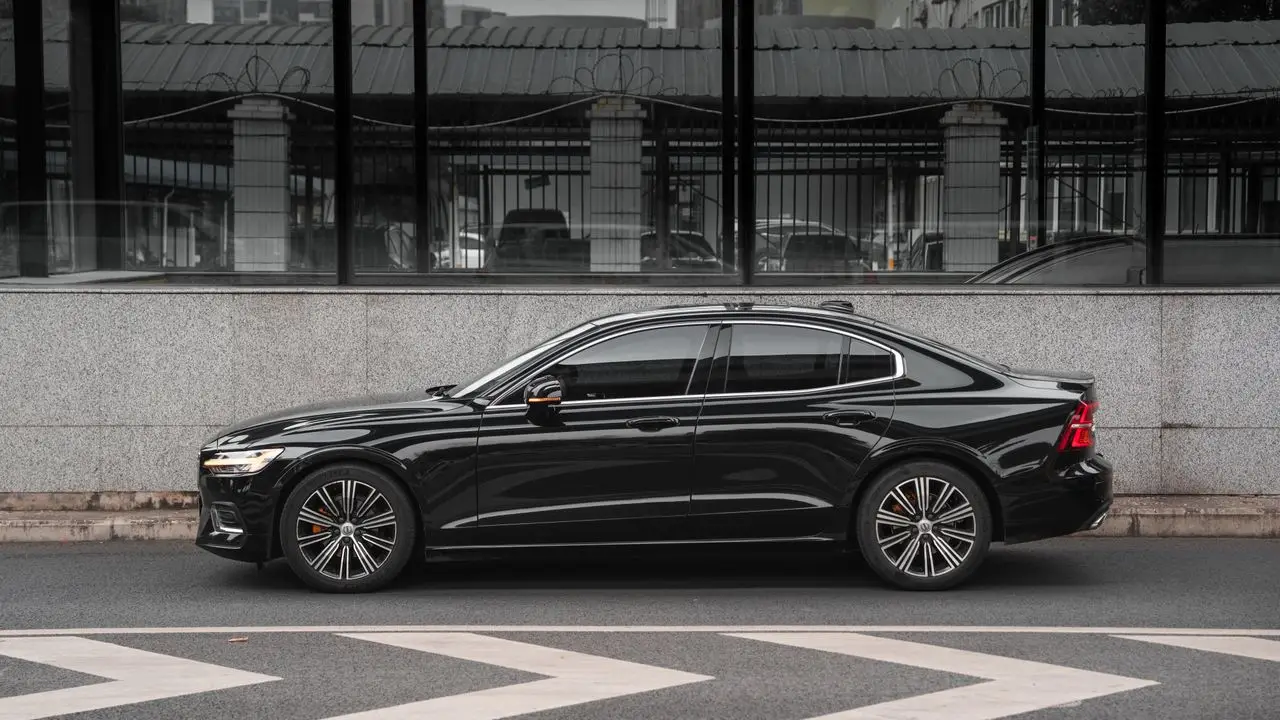

Sedans are a common body style featuring four doors, an enclosed trunk, comfortable seating, and balanced driving characteristics. This guide answers the question, “What is a sedan?” by explaining what characterizes this body style and the common sedan size categories. We’ll also look at some of today’s most popular sedan models.
What Is a Sedan?
The sedan meaning is relatively straightforward: a passenger car with a traditional three-box design, with each section housing separate compartments for the engine, passenger cabin, and trunk.
Most modern sedans have:
- Four doors
- Two rows of seating
- A fully enclosed trunk separate from the passenger compartment
- Seating for four or five occupants
At one point in the 20th century, “sedan” was a loose term that could include two-door models with a full rear seat and a more upright roofline. Today, two-door vehicles are often called coupes, though some automakers have applied the coupe label to four-door cars like the Mercedes CLA and CLS. That can be confusing, but contemporary sedans are best thought of as vehicles with the three-box body design, a fixed roof, and a separate cargo compartment.
Types of Sedans by Size
Sedan size has a different meaning by government standards. Instead of measuring exterior dimensions, the U.S. Environmental Protection Agency (EPA) classifies sedans and many other vehicles by interior passenger and cargo volume. These measurements establish the different class sizes.
Minicompact and Subcompact Sedans
Volume: <85 cubic feet (Minicompact) / 85–99 cubic feet (Subcompact)
Minicompact and subcompact sedans are typically among the most affordable new vehicles available, although they’ve been disappearing from the marketplace in favor of small crossovers. These most affordable sedans are designed for efficient operation and easy maneuverability, sometimes at the expense of rear seat and trunk space.
Typical characteristics include:
- Lower purchase prices
- Excellent fuel economy
- Easy parking in urban areas
- Seating for four or five passengers
Examples include:
- Nissan Versa (discontinued after 2025)
- Mitsubishi Mirage G4 (discontinued after 2024)
- Kia Rio (discontinued after 2023)
- Hyundai Accent (discontinued after 2022)
Compact Sedans
Volume: 100–109 cubic feet
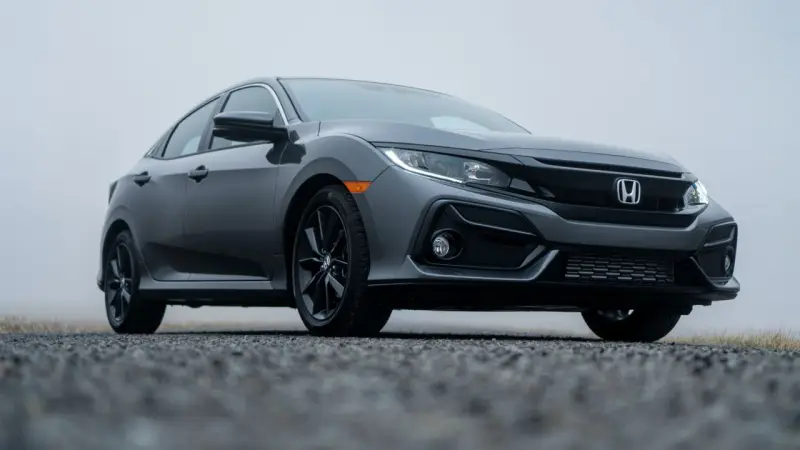
Despite the rise of SUVs, compact sedans remain a viable option in the new car market. This category offers more interior space without sacrificing affordability and fuel economy. While domestic automakers have given up on this category, many Asian and European brands have appealing entries.
Common characteristics include:
- More accommodating back seat
- Larger trunk size
- Available hybrid power
- Upscale options like a sunroof and heated front seats
Popular examples (with starting prices) include:
- Honda Civic ($24,700)
- Toyota Corolla ($23,100)
- Hyundai Elantra ($22,625)
- Mazda3 Sedan ($24,500)
Midsize Sedans
Volume: 110–119 cubic feet
Like the smaller compact sedan, the pool of new midsize sedans has shrunk. The remainder offer generous cabin space, usually with comfortable room for five, exceptional fuel economy for the hybrid variants, and the ability to equip these models almost like luxury sedans.
Typical advantages include:
- More spacious interiors
- Larger trunks
- Hybrid engine and all-wheel-drive options
- Greater ride comfort on long trips
Well-known examples (with starting prices) include:
- Honda Accord ($28,400)
- Toyota Camry ($29,000)
- Nissan Altima ($27,000)
- Hyundai Sonata ($27,700)
Full-Size (Large) Sedans
Volume: 120+ cubic feet
The market for large non-luxury sedans has also shrunk, with only Toyota and Dodge offering options. However, older models still offer the hallmarks of this segment: abundant rear seat space, comfortable highway cruising, and confident power.
Common features often include:
- Comfortable seating for five
- Near-luxury-level amenities on higher trims
- Hybrid and/or all-wheel drive configurations
- Ample trunk space
Examples include:
- Toyota Crown (New: $41,400)
- Dodge Charger (New: $52,000)
- Chrysler 300 (discontinued after 2023)
- Toyota Avalon (discontinued after 2022)
- Buick LaCrosse (discontinued after 2019)
Luxury Sedans
A luxury sedan is a broad label that applies to a variety of vehicles across different EPA size classes and price ranges. New models start in the mid-$40,000 range and can easily exceed $100,000 for high-end editions.
Common amenities usually include:
- Premium cabin materials
- Advanced technology
- Refined ride quality
- Performance powertrains
Popular examples (with starting prices) include:
- BMW 3 Series ($48,000)
- Mercedes-Benz C-Class ($49,600)
- Audi A6 ($59,200)
- Lexus ES ($47,700)
- Genesis G80 ($58,500)
- Mercedes-Benz S-Class ($118,900)
- BMW 7 Series ($97,300)
Sport Sedans
Sport sedans occupy a less-defined class. Some are performance variants of everyday models, while others are purpose-built power machines. These cars can also be compact, midsize, or luxury vehicles.
Compared with a conventional sedan, a sport sedan typically features:
- More powerful engines
- Sport-tuned suspension
- Quicker steering
- Larger brakes
- Performance tires
Well-known examples (with starting prices) include:
- BMW M5 ($120,700)
- Hyundai Sonata N Line ($35,500)
- Subaru WRX ($32,500)
- Cadillac CT5-V ($58,400)
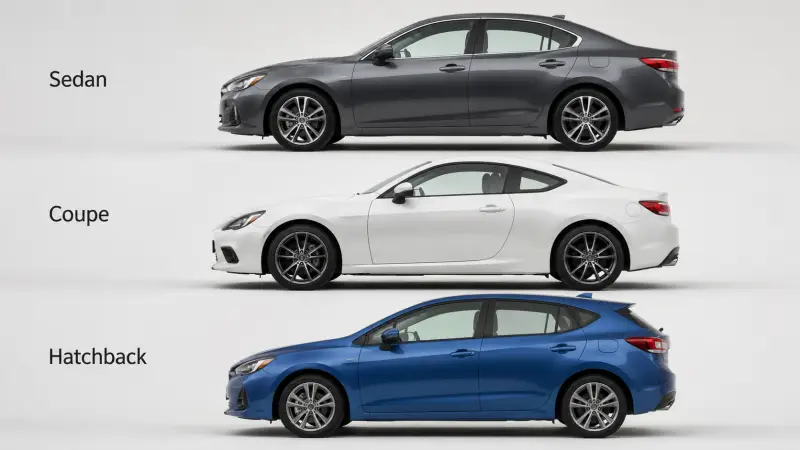
Sedan vs. Coupe vs. Hatchback: What's the Real Difference?
There are notable differences between these different body styles.
|
Feature |
Sedan |
Coupe |
Hatchback |
|
Doors |
Usually four |
Usually two |
Usually four or five |
|
Cargo Area |
Separate enclosed trunk |
Separate enclosed trunk |
Cargo area opens with the rear hatch |
|
Body Design |
Three-box |
Three-box |
Two-box |
|
Interior Space |
Usually 33+ cu. ft. |
Typically <33 cu. ft. |
Varies; larger cargo opening |
Although these body styles share some similarities, they're designed with different priorities in mind. Sedans emphasize comfort and practicality, coupes appeal to buyers seeking a sportier look, and hatchbacks offer greater flexibility for carrying bulkier items.
The EPA typically classifies coupes as having less than 33 cubic feet of combined passenger and cargo volume, while sedans usually exceed that threshold.
Popular Sedan Models by Segment
If you're still wondering what a sedan car means in today's marketplace, here’s a good overview of some of the different options from different categories.
|
Segment |
Popular Models |
|
Minicompact / Subcompact |
Nissan Versa, Mitsubishi Mirage G4, Kia Rio, Hyundai Accent (the latter three have been discontinued but remain common on the used market) |
|
Compact |
, Toyota Corolla, Hyundai Elantra, Mazda3 Sedan |
|
Midsize |
Honda Accord, Toyota Camry, Nissan Altima, Hyundai Sonata |
|
Full-Size |
Toyota Crown, Dodge Charger, Chrysler 300, Toyota Avalon, Buick LaCrosse (the last three are discontinued but remain popular used choices) |
|
Luxury |
BMW 3 Series, Mercedes-Benz C-Class, Audi A6, Lexus ES, Genesis G80, Mercedes-Benz S-Class, BMW 7 Series |
|
Sport |
BMW M5, Hyundai Sonata N Line, Subaru WRX, Cadillac CT5-V |
Pros and Cons of Sedans
Like every vehicle type, sedans have strengths and weaknesses.
Advantages
- Better fuel economy than many similarly sized SUVs
- Lower purchase prices
- Comfortable ride quality
- Easier parking and maneuverability
- Lower center of gravity for improved handling
Drawbacks
- Less cargo space than similarly sized hatchbacks and SUVs
- Lower ground clearance
- Limited towing capability
- Less flexible cargo area because of the separate trunk
- Fewer options with all-wheel drive
Popular Sedan Models to Consider
The real answer to what is a sedan car ultimately depends on what each shopper selects. These models are known for their value, reliability, efficiency, or performance.
Compact Sedans
- Honda Civic: A solid combination of sportiness and efficiency, along with a dash of refinement that’s less common in the class. Hybrid availability.
- Toyota Corolla: The world’s most popular car delivers notable fuel economy (especially in hybrid form) and a proven record of reliability.
- Hyundai Elantra: An unmatched new car warranty, generous standard features, and advanced technology make the Elantra a compelling alternative.
Midsize Sedans
- Honda Accord: Spacious interior, refined driving manners, and one of the segment's best hybrid systems.
- Toyota Camry: Standard hybrid power (starting in 2025), available front- or all-wheel drive, and Toyota's reputation for reliability give the Camry a leg up on the competition.
- Hyundai Sonata: Distinctive styling, a long list of standard features, and an available hybrid model help this Hyundai stand out.
Luxury Sedans
- BMW 3 Series: The benchmark compact sport-luxury sedan renowned for its balanced handling and strong performance.
- Lexus ES: Reliability, comfort, and quietness wrapped in a sleek Lexus exterior.
- Mercedes-Benz S-Class: A flagship luxury sedan featuring cutting-edge technology and one of the most refined interiors available.
Hybrid and Electric Sedans
- Toyota Camry Hybrid: Combines excellent fuel economy with the practicality of a midsize sedan and Toyota’s bulletproof hybrid technology.
- Honda Accord Hybrid: Delivers impressive efficiency without sacrificing interior space or driving refinement.
- Tesla Model 3: One of the best-selling electric sedans with competitive range, strong performance, and access to Tesla's Supercharger network.
- Hyundai Ioniq 6: An aerodynamic EV sedan with long driving range and ultra-fast charging capability on 800-volt DC fast chargers.
Frequently Asked Questions
Are sedans safer than SUVs?
Not necessarily. Today’s sedans and SUVs must meet the same federal crash standards administered by the National Highway Traffic Safety Administration (NHTSA). Most vehicles in showrooms today have four- or five-star overall NHTSA safety ratings. In addition, sedans tend to perform better than SUVs in government rollover evaluations. It’s best to judge safety by individual models rather than body style.
Why do some four-door cars get called "coupes"?
Some automakers, such as BMW and Mercedes-Benz, have adopted coupe-type terminology to describe sedans with fastback-style profiles. Despite the label, these four-door vehicles are usually classified as sedans for practical purposes, such as with DMV registrations.
Can a sedan have all-wheel drive?
Definitely. More automakers are making all-wheel drive available to keep sedans competitive with SUVs. Even mainstream models like the Toyota Camry, Nissan Altima, Kia K5, and Hyundai Sonata are available with this feature.
Are electric cars considered sedans?
It depends more on the body style than on the powertrain. EVs like the Tesla Model 3 and Hyundai Ioniq 6 clearly fall into the sedan segment.
Why are fewer automakers selling sedans today?
For more than a decade, consumer demand has shifted towards more versatile SUVs and crossovers. Consumers also like the improved visibility and higher seating positions offered by these vehicles. Sedans have disappeared completely from some lineups, like those of Chevrolet and Ford, while import brands have also cut back but still maintain a presence in the segment.