



Disclaimer: This article is for general informational purposes only and should not be considered tax or legal advice. Tax laws change periodically, and individual circumstances vary. Consult the IRS or a qualified tax professional regarding your specific situation.
Donating a vehicle to charity has many advantages. The organization benefits from the gift, you might be able to enjoy a car donation tax deduction, and there’s no hassle trying to sell or trade in the vehicle. However, making blanket assumptions about the tax write-off can lead to financial headaches. The value of the deduction depends on what the charity does with your car after receiving it, and new rules for vehicle donations may also affect your tax savings. Keep reading as we walk you through these details, explain how the deduction is calculated, and outline the paperwork you'll need.
Do You Qualify for a Car Donation Deduction?
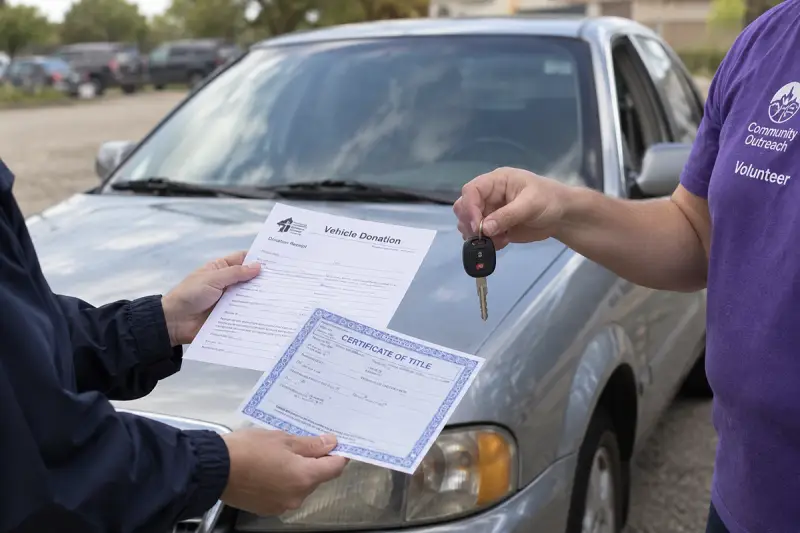
There’s more to donating a vehicle than selecting a charity and dropping off the car. To claim a car charity tax deduction, the IRS has two requirements:
- The donor must itemize deductions on their federal income tax return rather than claim the standard deduction.
- The vehicle must be donated to an IRS-qualified 501(c)(3) charitable organization.
Claiming the standard deduction and donating a vehicle, even to a qualified charity, won’t reduce your tax liability by a dollar. Use the IRS’s online Tax Exempt Organization Search Tool to determine if the charity is qualified to receive tax-deductible charitable contributions.
How the Deduction Amount Is Calculated
Many donors incorrectly assume that the tax deduction for a gifted vehicle equals its market value. However, this isn’t the case. Most of the time, the IRS requires the deduction to be based on what the charity does with the vehicle. Here are the three most common scenarios:
If the Charity Sells the Car
Charities usually raise funds from donated vehicles by selling them through auctions. In this situation, the deduction is generally limited to the gross proceeds from the sale, even if the vehicle’s fair market value (FMV) was higher.
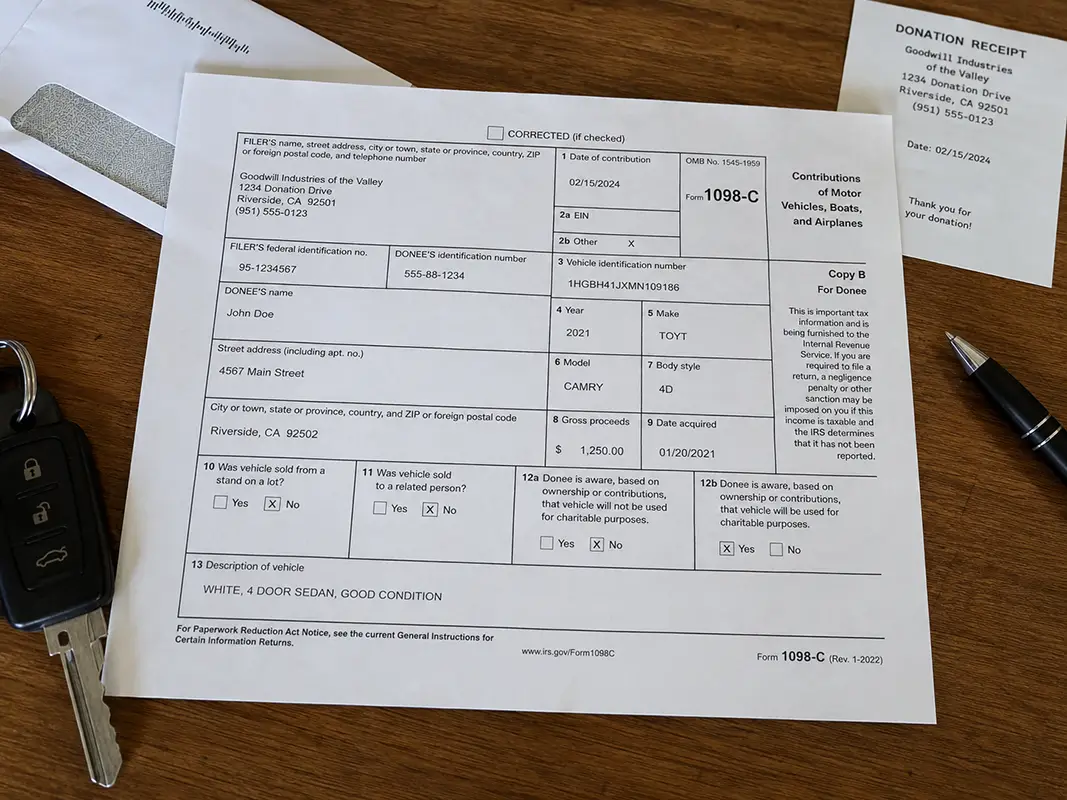
For example, if a vehicle with a $4,500 fair market value is sold through the charity’s auction for $3,000, the maximum deduction is usually limited to $3,000. The organization will report the sale price to the donor through Form 1098-C or a similar written acknowledgment.
If the Car Sells for $500 or Less
If the charity sells the vehicle for $500 or less, different IRS deduction rules apply. The donor may generally deduct the lesser of:
- The vehicle's FMV, or
- $500
For instance, if the charity sells the donated vehicle for $250 but its fair market value is $350, the deduction is generally limited to $350. On the other hand, if the vehicle's fair market value is $900, but the final auction price is $400, then the deduction is capped at $500.
If the Charity Uses or Gives the Car
While most donated vehicles are sold to raise funds, IRS rules provide exceptions that allow donors to deduct the vehicle's fair market value instead of the sale price in certain circumstances.
This larger car deduction donation might apply if the charity:
- Keeps the vehicle for its own charitable operations
- Makes significant improvements to the car before selling it
- Gives or sells the vehicle at a price well below FMV to a needy individual (as part of its charitable mission)
The charity’s written acknowledgment should indicate whether one of these exceptions applies.
How to Determine Fair Market Value
If you’re able to deduct a vehicle’s fair market value, that estimate must be reasonable and accurate. In general, FMV means the price a willing buyer would pay a willing seller in the absence of any unusual market pressure.
The IRS recommends using a reputable used-vehicle pricing guide and selecting a comparable vehicle based on its:
- Make
- Model
- Model year
- Mileage
- Overall condition
- Options or accessories
- Geographic area (local market)
Be realistic about the car's condition and fair market value. Claiming an unsupported or inflated deduction can draw additional IRS scrutiny if your return is examined or audited. If you're unsure of your vehicle's value, a GoodCar Fair Market Value report can provide another reference point before claiming the deduction.
Documentation and Tax Forms You'll Need
The value of the deduction determines the type of paperwork needed. Proper recordkeeping is critical as the IRS may deny a deduction if the documentation is missing or incorrect.
|
Claimed Deduction |
Required Documentation |
|
$500 or less |
Keep the donation receipt or written acknowledgment from the charity. No additional IRS form is usually required. |
|
$501–$5,000 |
Obtain Form 1098-C (or a qualifying written acknowledgment) from the charity and complete IRS Form 8283 (Section A). |
|
More than $5,000 |
Complete IRS Form 8283 (Section B) and obtain a qualified written appraisal, unless an IRS exception applies. |
The charity generally must provide Form 1098-C (or an equivalent written acknowledgment) within 30 days after selling the vehicle or, if an exception applies, within 30 days of the donation.
The 2026 Rule Change: The 0.5% AGI Floor
Taxpayers who itemize deductions face new limits on charitable deductions starting with the 2026 tax year. Charitable deductions, including vehicle donations, only apply to the extent they exceed 0.5% of the taxpayer's adjusted gross income (AGI).
For example, if your AGI is $100,000, under the new rule, the first $500 (0.5% of AGI) of charitable contributions generally doesn't qualify for a tax deduction. If your deductible charitable donations for the year total $3,000, only $2,500 would qualify as an itemized charitable deduction (assuming all other IRS requirements are met).
High-income donors face another limit in 2026: for taxpayers in the top 37% tax bracket, deductions, including charitable donations, are only worth 35 cents on the dollar in tax savings, instead of the usual 37 cents.
Common Mistakes That Can Cost You the Deduction
The IRS has specific rules and procedures for claiming a tax benefit for a vehicle donation. Failing to follow these requirements can eliminate this deduction. Common mistakes include:
- Donating to a non-qualified organization. Verify that the IRS recognizes the charity as a qualified 501(c)(3) organization before donating.
- Claiming the standard deduction. A vehicle donation generally provides no additional federal tax benefit unless you itemize deductions.
- Overestimating fair market value. Inflated valuations that don't reflect the vehicle's actual condition can lead to IRS scrutiny.
- Failing to keep the required paperwork. A missing form or the charity's written acknowledgment can result in a denied deduction, even if the donation itself qualifies.
Frequently Asked Questions
Can I claim a deduction for donating a car that doesn't run?
Yes. Many charities accept non-running vehicles and arrange for them to be towed. Whether the vehicle runs doesn't determine whether you qualify for a deduction. The IRS rules are based on what the charity does with the vehicle after receiving it and whether the donation meets other eligibility requirements.
Can I donate a financed car?
No. The charity usually needs to obtain a donated vehicle with a free-and-clear title to sell or give it away. A financed car will have a lien that must be satisfied before the title can be transferred to the charity.
Does donating a car reduce my taxes dollar-for-dollar?
No. A car donation provides a tax deduction, not a tax credit. A deduction reduces your taxable income, so the actual tax savings depend on your tax bracket and whether you itemize deductions.
Can I deduct the cost of repairs I made before donating the car?
Generally, no. Repair costs can’t be added to your charitable deduction. However, making repairs could increase the vehicle's fair market value or sale price, which may indirectly affect your deduction amount.
What happens if the charity doesn't send Form 1098-C?
If your deduction requires Form 1098-C or another qualifying written acknowledgment, you should contact the charity before filing your tax return. Claiming a deduction without the required documentation could result in the IRS denying it, even if the donation itself qualified.