


Colorado Lemon Law

Dependability is one of the most important aspects of a new vehicle. So, it's a big problem when your car breaks down multiple times in a short period or has a problem that severely decreases its value.
In 2024, Colorado expanded the terms of its lemon law to protect a broader range of consumers and allow more time to report a defect. These changes strengthened the law’s enforcement of manufacturer accountability and ensured that consumers have clearer options to seek compensation.
Although improved, consumers must meet Colorado's new filing deadlines and processes to benefit from its lemon law. These requirements include allowing the manufacturer time to fix the defect and reporting it early enough into ownership.
What is the Colorado Lemon Law
Colorado's lemon law safeguards consumers from getting stuck with an unsafe or inoperable vehicle. This law clearly defines the types of vehicles that qualify and the steps required before the manufacturer is compelled to offer compensation.
Previously, the state's lemon laws were overly vague, allowing manufacturers too much power when dealing with consumers who had been victimized.
The new statutes increase the time in which consumers can file their claims, expand coverage to small businesses, and sets a formula for calculating refund amounts.
The manufacturer is given a limited number of attempts and a specified time to rectify the nonconformity. Manufacturers that fail to repair their vehicles must either repurchase them from the consumer or offer a comparable replacement.
Not all vehicle types are covered by the Colorado lemon law. Most conventional vehicles are protected, including passenger cars, pickup trucks, and vans. The lemon law does not cover the following:
- Motorcycles
- Motor Homes
- Buses
- All-terrain vehicles
How Does Colorado Lemon Law Work?
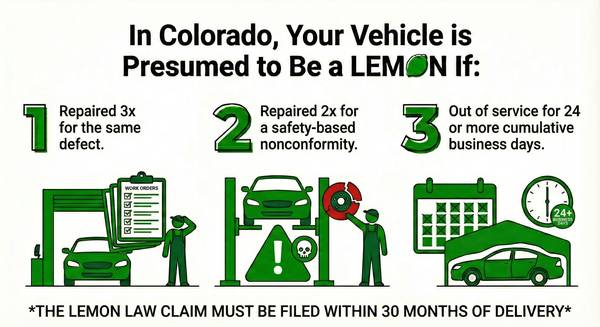
The updated Colorado lemon law has more lenient filing deadlines and consumer protections in the country. Consumers now have up to two years or 24,000 miles after delivery to report a defect to the manufacturer. This report obligates the manufacturer to repair the nonconformity in a reasonable timeframe.
Colorado only allows the manufacturer two to three repair attempts or for the service facility to hold the vehicle for a total of 24 business days. The manufacturer is then given ten days to make a final repair attempt before providing remedy options.
Manufacturers and dealerships that fail to comply will face disciplinary options. Consumers can report unwilling manufacturers to the Colorado Attorney General's Office.
Step-by-Step Process
Step One: Confirm the Defect and Vehicle Qualify
A lemon must be a qualifying vehicle type and have a significant defect to warrant compensation. The Colorado lemon law covers the most common types of personal vehicles, including passenger cars, pickup trucks, vans, and SUVs.
Unlike some other states, Colorado's lemon law can be invoked by small businesses, but it does not cover used vehicles. The business must still use an appropriate vehicle type, excluding items such as buses, motorcycles, RVs, and commercial equipment.
The vehicle must also have a significant defect. This term refers specifically to defects related to the vehicle's safety or market value. Previously, safety defects were not covered unless they impacted the vehicle's value, which was one of the significant changes in the recent update.
Step Two: Report the Defect and Start Repairs
A vehicle is not a lemon until you have shown that the defect cannot be fixed in a reasonable period. The manufacturer has a limited number of repair attempts to address the defect, depending on its severity.
Contact the dealership where you bought the vehicle, report the defect, and schedule the first repair attempt. Ensure that you retain some form of confirmation that you reported the defect in a timely manner. If the defect affects your safety, you may have to arrange a tow to the repair location.
Repairs must be performed at a facility operated or approved by the manufacturer. The manufacturer can attempt up to three repairs on the same defect; this is lowered to two attempts if the defect is likely to result in severe bodily harm.
However, the vehicle also cannot be held out of service for more than 24 business days. This ensures that service facilities act expeditiously and do not hold the vehicle out of service h for endless repairs.
The repair facility is legally required to provide you with a summary after each attempt. This receipt tracks dates, expenses, mileage, and proves that the same defect persists across multiple visits.
Step Three: Send Notice for Final Repair
You must inform the manufacturer that their service facility has failed to fix the defect in a reasonable timeframe. The manufacturer must receive it within thirty months of the vehicle's purchase.
The vehicle will not meet the reasonable repair requirement until this notice arrives. Therefore, you should send it with a certified carrier that includes a return receipt request. A return receipt is proof of when the manufacturer received the notice.
After notifying the manufacturer, they have an additional ten business days to repair the defect. If they fail this time, then the vehicle is deemed a lemon, and they must pay compensation.
Step Four: Compensation
The manufacturer can negotiate remedies with you, but the offer must meet minimum compensation requirements for failing to fulfill their warranty promises. It is the manufacturer's choice whether to offer a refund or a comparable replacement vehicle.
Refunds must start at the full sales contract price, and replacement vehicles must be of comparable value to the lemon, provided it was defect-free. Typically, a replacement vehicle will be the same make and model as the lemon.
A reasonable allowance for use can also reduce the refund value. This refers to the devaluation of the vehicle due to use. Only the mileage accrued before the defect was reported and between repair attempts counts toward the reasonable allowance.
Colorado Lemon Law Qualifications
Vehicles must have specific qualities to be a lemon. It must be the right vehicle type, be designed for highway use, and travel on four wheels. Consumers must also complete all steps of the lemon law process; otherwise, the manufacturer cannot be compelled to compensate you.
The primary qualifications of a lemon include:
- Vehicle is "conventional" and used primarily for personal or small business purposes
- Vehicle suffers from a substantial nonconformity affecting its safety or market value
- Vehicle is newly purchased or leased from a Colorado-licensed seller
- The manufacturer or its agent was notified of the defect within the deadline
- The manufacturer failed to repair the defect in a reasonable period
Significant Defect
The vehicle must fail to conform to the manufacturer's warranty due to a defect affecting the vehicle's safety or market value. The manufacturer may agree to repair minor problems, such as a squeaky chair, but those types of issues cannot compel them to replace or refund the vehicle.
It is possible to argue that any problem can be a safety risk, so Colorado only permits significant safety defects to trigger a lemon claim. A significant safety-based nonconformity is any issue that will likely cause death, severe bodily harm, or create a risk of fire when driven.
The lemon law is unclear about what threshold constitutes a significant decrease in the vehicle's market value. Many other states define a significant devaluation as anything surpassing ten percent, but it may be necessary to consult a lemon law attorney for their recommendation.
It is essential to understand that Colorado's lemon law only covers defects caused by the manufacturing process. Issues that arise due to third-party modifications or owner neglect will not qualify.
Vehicle Types
Colorado's lemon law applies to newly purchased or leased motor vehicles purchased within the state. The act uses the following qualifications to determine what vehicle types are acceptable:
- Designed for transporting fewer than ten people on the highway
- Self-propelled private passenger vehicle
- Designed to drive with more than three wheels on the road
Passenger cars, pickup trucks, SUVs, and vans are covered under these terms, as are most other traditional personal and household vehicles. However, less common vehicle types, such as motorcycles, mobile homes, ATVs, and any towed living facility, are excluded from coverage.
Small businesses can submit lemon law claims after buying a defective vehicle. The business is treated as a consumer, but the returned vehicle must meet all requirements that a regular person is subject to.
Reasonable Number of Repair Attempts
Colorado's lemon law presumes that a manufacturer has had a reasonable opportunity to repair the defect. The manufacturer fails to meet this standard if either of the following situations occurs:
- The same defect persists after at least three repair attempts
- A safety-based nonconformity persists after at least two repair attempts
- The vehicle has been held out of service for repairs for at least 24 cumulative days
After meeting any of these conditions, the manufacturer then has a 10-day limit to attempt further repairs.
Additionally, the defect must be reported within the lemon law period. This deadline lasts for up to two years after the vehicle's original delivery or the first 24,000 driven miles, whichever occurs first.
Strong documentation is necessary to prove you have satisfied a "reasonable number of repair attempts." The manufacturer's service facility is required to provide you with service receipts; however, it is your responsibility to store them for future reference.
Colorado Lemon Law Rights Period and Time Limit
Colorado's lemon law has two deadlines relevant to the consumer. The first is the deadline for notifying the seller, and the second is the deadline for completing the entire lemon law process. Missing either deadline can disqualify your claim and stick you with a broken-down lemon.
You must report the defect to the manufacturer or the dealership within two years of the vehicle's original delivery date or 24,000 miles added to the odometer. This deadline prevents consumers from initiating a lemon claim for defects that occur during long-term use.
This two-year deadline does not need to encompass all of the manufacturer's repair attempts. All you need to do is notify them about the problem within this timeframe. Colorado requires that the manufacturer continue their repair attempts even if this period lapses partway through.
However, the statute of limitations on any lemon claim is thirty months after the vehicle's original delivery date. This is the time limit for completing the claims process, including receiving compensation or filing a claim with the Colorado Attorney General's Office.
It is recommended to start the process as early as possible and schedule repair appointments as soon as the defect appears or reappears.
Compensation and Remedies Under Colorado Law
Manufacturers must offer remedies to consumers who purchase defective vehicles that their repair facilities cannot fix. Colorado allows manufacturers to choose whether to provide a refund or a replacement vehicle, but both options must offer a fair value to the consumer.
Refunds
The manufacturer may repurchase the defective vehicle from the consumer. The refund value is equal to the lemon's original purchase price, accounting for an allowance for use.
The recent lemon law update added a more precise calculation for this allowance. The allowance for use is found by dividing the accrued mileage by 100,000 and multiplying the result by the original purchase price.
For example, imagine you bought a vehicle for $40,000 and drove it for 10,000 miles before reporting the defect. The manufacturer would divide the 10,000 miles by 100,000 to get a fraction of 1/10. Then multiply 1/10 by $40,000, for a $4,000 allowance for use.
In this scenario, you would receive a refund of $36,000. This value may increase due to the manufacturer covering incidental costs, such as sales tax, registration fees, license fees, and other governmental expenses.
Replacements
Rather than a refund, the manufacturer can provide a replacement vehicle of comparable value and features. The replacement must be new and include all standard warranties included with the original vehicle.
In most cases, the manufacturer will offer the same make and model as the lemon. This method is easiest for accommodating existing financing agreements and ensuring the value of both vehicles is equal.
Why Work With a Colorado Lemon Law Attorney

Working through Colorado's lemon law process can be confusing. Many online sources have not been updated to reflect the state's revised statutes, making it easy to become confused about the different steps.
A qualified attorney begins by determining whether your vehicle meets the legal requirements outlined in the act, confirming your claim is legitimate. They will then guide you through the repair process, managing repair receipts and ensuring compliance with all relevant deadlines.
Your attorney can also communicate directly with the seller on your behalf, reducing stress and helping to catch any shady tactics. If the manufacturer fails to comply, your attorney knows when to initiate a claim and the best strategies to prevent a lengthy court confrontation.
Best of all, most lemon law attorneys practice on a contingency basis. This means that they only earn if your claim is successful. This arrangement motivates them to maximize winnings, but also keeps you safe from excessive fees in case of an unsuccessful claim.
FAQ
No. Colorado's Lemon Law applies only to newly purchased or leased vehicles. It does not matter if a used vehicle is still covered by its original warranty.
You must file a claim against the manufacturer within the statute of limitations, which lasts for thirty months after the vehicle's original delivery. However, you only have two years to first report the defect to the manufacturer or dealership.
Colorado's lemon law applies to most conventional vehicle types, including passenger cars, vans, SUVs, and pickup trucks. The act does not cover vehicles designed to transport large groups or those that travel on fewer than four wheels.
A substantial defect refers to problems that significantly impair the vehicle's safety or market value. Safety issues must be likely to cause death, severe bodily harm, or result in fire or explosion.
Colorado law determines that your car has gone through reasonable repair attempts if it meets any of the following conditions:
- The same defect has failed to be fixed after at least three repair attempts
- A serious safety defect persists after at least two repair attempts
- The vehicle has been out of service for a cumulative total of 24 days or more
Once any of these conditions are met, the manufacturer has a final opportunity to repair the vehicle within a ten-day timeframe.
Vehicle owners with a qualified lemon are entitled to either a comparable replacement vehicle or a refund for the original purchase price minus an allowance for use. The manufacturer may choose which remedy option to provide.
Refunds also include collateral costs, such as registration fees, title fees, sales taxes, and other governmental expenses.
Colorado does not have a state-sponsored arbitration process. You can file a complaint with the state's Attorney General's Office, which may compel the manufacturer to comply. However, consumers are not required to file a complaint before seeking a court remedy.
Colorado Resources



FREE Vehicle Search
- Accidents
- Problem Checks
- Title Records
- Recalls
- Values
- Specs


-
 InfoPay, Inc. (dba GoodCar) is an Approved NMVTIS Data Provider
-

-
