


Massachusetts Lemon Law

Returning a car can feel intimidating. It is easy to convince yourself that you can live with some problems as long as the car continues to run. However, consumers shouldn’t settle for anything less than what the manufacturer promises in their warranty.
Lemon laws exist to provide consumers with a clear and structured process for returning a defective vehicle to the dealership. These laws differ between states, but are typically as lenient as possible for the consumer without inviting fraud.
Under these laws, manufacturers and their authorized agents (dealerships) are required to repair the vehicle in accordance with warranty expectations. If they fail, then they are legally compelled to compensate the consumer by repurchasing or replacing the vehicle.
What Is the Lemon Law in Massachusetts?
Massachusetts’ lemon law makes it easy for consumers to seek compensation after buying a defective new vehicle. Affected owners must report a substantial defect to the manufacturer and allow them a reasonable opportunity to repair it.
The manufacturer must offer fair compensation to the consumer if they fail to repair the vehicle to warranty standards. All repairs must occur within Massachusetts’ “term of protection.” This period lasts until you have owned the vehicle for one year or driven over 15,000 miles.
The law covers new cars, trucks, motorcycles, and vans, provided they were purchased or leased for household or family purposes. There are also protections for repurchased vehicles, albeit with added conditions.
Used vehicles must have under 125,000 miles on the odometer at the time of sale. Some vehicles can be protected after this mileage point, but only for severe issues. The new owner has only seven days to report the issue to the manufacturer.
The Massachusetts lemon law does not cover all vehicle types, including:
- Recreational vehicles
- All-terrain vehicles
- Mobile homes
- Vehicles with defects caused by neglect or third-party modification
- Vehicles obtained for resale or business purposes
How Does Massachusetts’ Lemon Law Work?
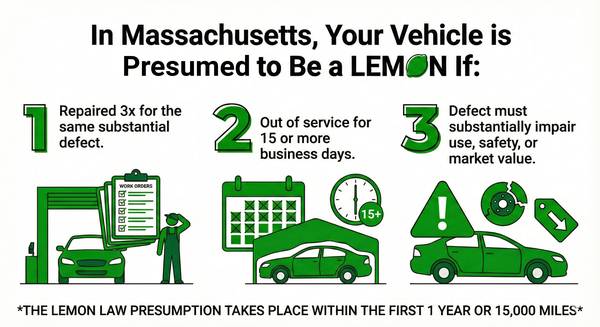
Massachusetts’ lemon law has a tighter timeline than many other states. Consumers have a maximum of one year to report and comply with the requirements for reasonable repair. This means that it is best to bring the vehicle in immediately upon recognizing a substantial defect.
Once brought in, the manufacturer has a limited opportunity to conform the vehicle to their warranty. Massachusetts defines failure in two ways:
- The vehicle has been in repair for over 15 days
- The manufacturer has not repaired the same defect after three attempts
The manufacturer then has a final opportunity to repair the defect before being required to offer compensation. If they do not comply or offer unsatisfactory terms, then you may have to seek arbitration.
There are numerous details and requirements built into each of these steps, which are expanded upon below.
Step-by-Step Process
Step 1: Confirm the Vehicle Qualifies
The vehicle and its defect must meet minimum requirements to qualify for Massachusetts’ lemon law. These standards prevent consumers from fraudulently returning their cars for minor issues and overwhelming manufacturers with claims.
For starters, the vehicle must have been purchased or leased from a seller operating in Massachusetts. This vehicle must be primarily used for personal, family, or household purposes, which disqualifies vehicles purchased for resale or business use.
The vehicle must also be an appropriate type. Massachusetts’ law covers most household vehicles, including motorcycles, but does not protect commercial trucks, off-road vehicles, or modified vehicles.
Lastly, the defect must be severe enough to substantially affect the vehicle’s use, safety, or market value. Generally, qualifying defects will impair the driver’s control or safety when the vehicle is in use.
For example, a substantial defect includes things like unresponsive brakes or a damaged steering column, but not a squeaking car seat.
Step 2: Allow Repair Attempts
If you believe your vehicle qualifies as a lemon, you must inform the manufacturer of the problem. The manufacturer is then allowed a reasonable opportunity to fix the defect before discussing compensation.
Massachusetts’ lemon law does not require the manufacturer to arrange a tow for your vehicle, but they are required to reimburse you if your car is a lemon.
Massachusetts has two metrics for determining when the manufacturer has had enough time or the consumer is unnecessarily burdened.
Either of the following metrics must be met within the term of protection. This period expires one year after the date of original delivery or 15,000 miles added to the odometer, whichever occurs first.
The first metric is met if the same defect persists after the vehicle has been in repair at least three times. The manufacturer or their chosen facility must perform these repair attempts to count toward the total.
The second metric occurs if the vehicle is out of service for a cumulative total of fifteen days. This statute prevents manufacturers from holding the vehicle for an indefinite period for each service attempt. Only days that the service facility is open count toward the fifteen-day total.
Step 3: Final Repair Attempt
Upon meeting either condition, the manufacturer is allowed a final repair attempt. The manufacturer has up to seven business days to repair the defect; otherwise, they must offer compensation terms.
You must also send a written notice to the manufacturer within fifteen months of the vehicle’s original delivery. It is recommended to request a return receipt to prove that the manufacturer received the notice before the deadline.
The mailing address is available in the owner’s manual provided by the dealership, but you can also ask the dealership directly. An example letter can be found here.
Step 4: Compensation
You may pick up your vehicle after the final repair attempt time period ends. You do not have to agree to any additional repair attempts. At this point, the manufacturer will discuss compensation options if the defect still exists.
Available options include a refund for the full purchase price or a comparable replacement vehicle. Neither party may demand a replacement vehicle rather than a refund.
The refund must be for the full contract price of the vehicle. Incidental costs incurred as a direct result of the lemon are also refunded, such as towing and registration fees. However, the refund can also be reduced based on the extent to which you used the car prior to reporting the defect.
Receiving a replacement vehicle triggers a new term of protection. The new vehicle is subject to the same lemon law protections as the previous one. The manufacturer must also reimburse all incidental costs.
Step 5: Apply for Arbitration
If the manufacturer does not offer compensation, then you may apply for arbitration through the Massachusetts Office of Consumer Affairs and Business Regulation. The office must receive your request within eighteen months of the vehicle’s original delivery.
Arbitration is a more expedient alternative to court. A third party reviews claims from both parties and renders a final judgment. You will need to submit records from all service attempts and communications with the manufacturer or its agents, proving that your vehicle met all lemon requirements.
The manufacturer cannot refute the arbitration board’s judgment. However, the consumer retains the right to escalate the matter to court.
Massachusetts Lemon Law Qualifications

Vehicle owners must meet multiple requirements to qualify for compensation. The lemon law restricts vehicle types and only accepts significant defects. Additionally, the vehicle must have been purchased or leased from a Massachusetts-licensed dealer.
Consumers must also follow the proper procedures. This involves allowing the manufacturer a reasonable number of repair attempts and sending notices to the manufacturer. Without these steps, it does not matter how defective the vehicle is; it will not be deemed a lemon.
A quick breakdown of the Massachusetts lemon law qualifications includes:
- Vehicle was purchased or leased in Massachusetts
- Vehicle is a passenger car, motorcycle, passenger truck, or van
- Vehicle is newly purchased or was purchased with fewer than 125,000 miles
- Vehicle is within the term of protection
- The manufacturer failed to repair the vehicle after a reasonable opportunity
Vehicle Types
Massachusetts lemon law protects passenger cars, lightweight trucks, vans, and motorcycles. These vehicles must be primarily used for personal, family, or household purposes. Business or commercial vehicles do not qualify.
Consumers can initiate the lemon law process for used vehicles if the vehicle had fewer than 125,000 miles on it at the time of sale. However, the new owner cannot add more than 15,000 miles to the odometer.
Reasonable Repair Attempts
The manufacturer must have a reasonable number of repair attempts before your vehicle can be deemed a lemon. All repairs must be performed at a manufacturer’s service facility to be eligible under the lemon law.
The first way to determine if the manufacturer has had a reasonable opportunity for repairs is if they have made at least three attempts to address the same defect.
You must document the existing problems before each service attempt. Doing so proves that the service facility was aware of the problem but failed to fix it in a timely manner.
The service facility is also legally required to provide you with an itemized summary of the repair attempt, including the dates and services rendered.
A reasonable number of repair attempts also occurs if the vehicle is held in repair for fifteen business days or more. Only days in which the service facility is open are counted.
Term of Protection
The term of protection, also called the lemon rights period, is the maximum time during which you can fit in the manufacturer’s reasonable repairs. Within this period, the manufacturer must attempt three repairs for the same defect or hold the vehicle for fifteen business days.
Significant Defects
Not all defects are lemon-worthy. Massachusetts’ lemon law only accepts substantial defects that significantly damage the vehicle’s use, safety, or market value.
For example, broken blinkers and malfunctioning seatbelts put the driver and passengers in increased danger. Other sufficient defects are those that impair the driver’s control over the vehicle.
Massachusetts also states that the “decreased market value” requirement must lower the vehicle’s worth by at least ten percent to qualify as a significant defect. This means that minor scratches or other minor cosmetic problems are unlikely to qualify.
Massachusetts Lemon Law Rights Period and Time Limit
There are three deadlines within the Massachusetts lemon law claims process.
The term of protection lasts for one year or until the car is driven 15,000 miles, whichever occurs first. This period begins right upon the vehicle’s delivery to its owner. Replacement vehicles provided through a lemon law claim benefit from a renewed term of protection.
Consumers must allow the manufacturer to make all their reasonable repair attempts within the term of protection.
The second deadline lasts for up to fifteen months after the vehicle’s original delivery. This is the time limit for the manufacturer to receive your final repair notice, which must be sent to inform the manufacturer that they have failed to repair the vehicle within a reasonable timeframe.
The final deadline ends eighteen months after the vehicle’s original delivery. This is the latest date you can request arbitration with the Massachusetts Office of Consumer Affairs and Business Regulation. This is necessary if the manufacturer does not offer fair compensation.
Massachusetts’ lemon law deadlines are relatively tight compared to other states. Therefore, delaying any step or failing to keep detailed records can jeopardize your ability to obtain relief.
Compensation and Remedies Under Massachusetts Law
Manufacturers may choose between offering a refund or a replacement for a lemon. Both options will reimburse the consumer for incidental costs, including towing and rental fees. The manufacturer cannot compel the consumer to choose a replacement.
Before making your choice, here is a breakdown of what each option involves.
Refund
In a refund, the manufacturer repurchases the lemon for its full contract sales price. This price includes the value of any credit or allowances for trade-in vehicles. Leased vehicles are refunded an amount equal to the total payments made.
The amount may be reduced based on an allowance for use. This allowance is typically calculated by multiplying the purchase price by the miles driven before the defect was first reported. This value is divided by 100,000 and taken from the full contract sales price.
Creditors are paid first if there is an active lien on the title.
Replacement
If you prefer a replacement, the manufacturer must offer a vehicle of comparable value and quality. In most cases, the manufacturer will suggest the same make and model as the lemon. The replacement will initiate a new term of protection and be accompanied by a renewed warranty.
A reasonable allowance for use of the original vehicle does not reduce the value of the replacement vehicle offer. This means that if you paid $40,000 for the original vehicle, then the new vehicle must be worth at least $40,000.
The manufacturer is also prohibited from forcing the consumer to refinance or enter a new payment agreement for the replacement vehicle.
Why Work with a Massachusetts Lemon Law Attorney

The Massachusetts lemon law is designed to facilitate easy resolution for consumers with major manufacturers. However, some dealers put off responding or scheduling repair appointments. They make every effort to slow down a lemon claim.
Massachusetts already has a shorter lemon rights period, and these strategies may make an unsuspecting consumer miss their window. So, it is often helpful to work with a Massachusetts lemon law attorney.
Not only do these lemon law specialists ensure that manufacturers treat you fairly, but they also help maintain documentation, send official notices, and meet deadlines. The lemon process is lengthy, and many details can be overlooked if you work on it alone.
Many Massachusetts Lemon Law attorneys work on a contingency basis, meaning you pay nothing unless you win. In a successful case, the manufacturer is typically responsible for your attorney's fees, making hiring an attorney a relatively low-risk decision.
FAQ
Yes, the Massachusetts lemon law protects used cars that were sold with fewer than 125,000 miles on them and are still covered by the original warranty.
Vehicle owners must report the nonconformity and allow the manufacturer to make reasonable repair attempts within the term of protection (1 year or 15,000 miles).
However, affected consumers have up to eighteen months to file an arbitration request to the Massachusetts Office of Consumer Affairs and Business Regulation.
No. You are not required to seek arbitration before suing the manufacturer in Massachusetts. However, it is often recommended to utilize the program, as it may strengthen any eventual court claims and is typically much faster.
A substantial defect is an issue that significantly impairs the vehicle’s use, safety, or market value. For value impairment, you must prove that the defect reduced the value by at least ten percent.
Manufacturers can offer to refund or replace the lemon. Both options will also refund the cost of collateral charges directly caused by the lemon, including registration fees, rental costs, and towing.
If you are successful in your court claim, then the manufacturer must pay for any reasonable attorney’s fees. Most lemon law specialists work on a contingency basis, so you won’t have to pay if you do not win.
Yes. Massachusetts’ lemon law covers both leased vehicles and motorcycles. However, it does not cover motor homes, recreational vehicles, or all-terrain vehicles.
Massachusetts Resources



FREE Vehicle Search
- Accidents
- Problem Checks
- Title Records
- Recalls
- Values
- Specs


-
 InfoPay, Inc. (dba GoodCar) is an Approved NMVTIS Data Provider
-

-
