


Michigan Lemon Law

Cars need repairs from time to time, but it is not normal for a new vehicle to experience repeated mechanical failures. Defects such as stuck steering wheels, unresponsive brakes, or loose panels are not only annoying but also life-threatening.
States create Lemon Laws to shield consumers against these kinds of manufacturer mistakes. These statutes require manufacturers to fulfill warranty promises by defining when they are obligated to either refund or replace the vehicle.
However, not all vehicles are covered by Lemon Laws. Owners must report the lemon within a specified deadline and give the seller a reasonable opportunity to repair the defect. These requirements vary by state, but Michigan allows ample time for the process.
What is the Lemon Law in Michigan?
Michigan's Lemon Law, outlined in Act 87 of the Michigan Compiled Laws, applies to vehicles with any defect that significantly impairs their use or value. This definition typically applies to problems that prevent the lemon from conforming to the manufacturer's express warranty.
If the vehicle matches Michigan's requirements, then the manufacturer is required to provide compensation to the affected consumer. The manufacturer may offer a comparable replacement vehicle or a refund for the full purchase or lease price of the lemon.
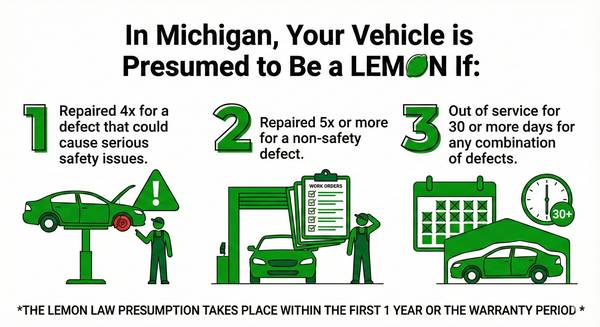
Michigan allows the manufacturer a minimum of four attempts or thirty days to repair the vehicle, aligning with their warranty. The owner must report the issue before the warranty expires or within a year of delivery, whichever comes first.
This act applies to passenger vehicles, SUVs, light trucks, and vans. Some vehicle types that are not protected include the following:
- Motorcycles and Mopeds
- Electric bikes
- Motor homes
- All-terrain vehicles
- Buses
- Commercial trucks
How Does Michigan's Lemon Law Work?
If you identify a serious defect violating the manufacturer's warranty, you must inform the dealer as soon as possible. The dealership must perform repairs on the vehicle, provided the defect was reported within the first year after delivery.
Vehicle owners must also send a separate notice to the manufacturer. This notice initiates the dealer's "last chance" to complete satisfactory repairs before they are forced to offer compensation options.
In many cases, consumers can opt for an arbitration hearing through the BBB Auto Line Program. This is a third-party service that facilitates communication between the consumer and the manufacturer, ensuring that both parties follow the legal procedure.
Arbitration can significantly ease the mental burden of dealing with a lemon; however, not all manufacturers participate in the program.
Step-by-Step Process
Step 1: Confirm You and Your Vehicle Qualify
The Michigan New Vehicle Warranty Act specifies the types of people and vehicles that qualify for protection.
The "consumer" refers to an individual who has purchased or leased a new motor vehicle for personal, family, or household use. This means that someone who buys a vehicle for resale is not eligible. The statute goes so far as to exempt persons who purchase ten or more motor vehicles in a year.
The vehicle must be a four-wheeled personal vehicle, such as passenger cars, SUVs, and non-commercial trucks. Additionally, it must have a defect that significantly impairs its use or value. For example, consistent brake failure would qualify, but minor exterior scratches would not.
Step 2: Directly Notify the Dealer
Once you're convinced you have a lemon, you must report the nonconformity to the dealer. Send an email or written letter describing the problem and schedule a repair attempt. Whatever method you choose, make sure to keep a copy for your records.
This notice creates proof that you informed them about the defect within the first deadline. Any defects reported after the express warranty expires or more than one year after the initial delivery are not covered under the Michigan Lemon Law.
Step 3: Allow Repair Attempts and Send Final Notice
The Michigan New Vehicle Warranty Act states that manufacturers must provide a reasonable opportunity to repair the vehicle. This condition is met if either of the following situations occurs:
- The manufacturer has failed to repair the same defect after four attempts
- The vehicle has been out of service for a total of thirty or more days within the first year
The Lemon Law also requires that the consumer send the manufacturer written notice of their "last chance" to address the issue. This notice must be sent via return receipt service, and only after the third repair attempt or after the vehicle has been in the repair facility for at least 25 days.
Consumers can find the manufacturer's mailing address in their vehicle owner's manual or through the dealership.
After receiving the notice, the manufacturer will point the owner to a reasonably close repair facility. This location has either one more repair attempt or five days to fix the defect.
Step 4: Compensation
If the defect remains unfixed after the final notice, the manufacturer is then legally obligated to offer compensation. Potential remedies include exchanging the vehicle for a comparable replacement or receiving a refund for the full purchase price of the lemon.
The law also recognizes that a defective vehicle costs more than just the purchase price. The owner may have faced related financial burdens such as towing expenses, rental vehicle payments, and registration fees. These collateral costs are built into the refund.
Step 5: Going to Court
Consumers may wish to explore alternative legal remedies. This process is typically more time-consuming than arbitration, but it may be warranted in certain situations.
However, if available, the consumer must utilize the manufacturer's arbitration process before filing a lawsuit. The manufacturer is bound to the arbitration board's decision, but consumers retain the power to pursue an appeal in court.
It is best to bring in a Michigan Lemon Law specialist for any court action. These attorneys can identify where the arbitration board may have made a mistake or if the manufacturer failed to fulfill all its obligations.
These professionals also do not typically charge fees in unsuccessful cases. They work on a contingency basis, meaning they deduct their fees from the winnings. This means there is little financial risk to asking for their help.
Michigan Lemon Law Qualifications

In general, Lemon Laws favor the consumer. They are in place to protect people from getting bullied or severely inconvenienced by large corporations. However, these laws must set strict requirements, or ill-intentioned people will take advantage of the system and commit fraud.
The following qualifications help to prevent fraud:
- Purchased within Michigan or by a Michigan resident
- Vehicle defect must be reported while the manufacturer's warranty is active
- Lemon must be a "typical" household vehicle type
- Defect must substantially impair the vehicle's use or value
- The manufacturer must fail to fix the defect in a reasonable number of attempts
Consumer Requirements
Michigan Lemon Law only applies to vehicles purchased or leased within Michigan, or by a permanent resident of Michigan. Therefore, a Michigan resident can purchase a vehicle from another state and still receive the same protections.
The consumer must also have obtained the defective vehicle for personal, family, or household use. Michigan does not cover vehicles purchased for business or resale purposes.
Vehicle Types
Michigan's Lemon Law only covers the most conventional types of vehicles. Commonly seen vehicles, such as passenger cars, lightweight trucks, vans, and SUVs, are eligible.
The statute excludes any vehicles that do not use four wheels, automatically disqualifying motorcycles, boats, commercial trucks, and buses.
Michigan Lemon Law also applies to used vehicles that are still under the manufacturer's express warranty. The new owner must also report the defect to the vehicle's original owner within one year of the delivery date.
Substantial Nonconformity
The reported nonconformity must have a significant impact on the vehicle's use or value. This definition may sound vague, but it generally refers to any issue serious enough that a reasonable person would feel unsafe or cheated after learning about it.
Some examples of substantial nonconformities include:
- Persistent engine problems
- Steering defects
- Electrical-related malfunctions that affect safety
In contrast, minor irritants like rattling or paint imperfections do not meet this standard. The defect also cannot be the result of abuse, neglect, or third-party modifications.
Failed Repair Attempts
To qualify as a lemon, the manufacturer must fail to repair the defect in a reasonable time. This roadblock incentivizes manufacturers to maintain repair facilities, but also prevents consumers from constantly returning cars for a one-time defect.
Michigan law establishes two presumptions for determining whether the manufacturer has had a "reasonable" opportunity.
The first presumption is that the same defect has not been fixed after four or more attempts have been made. The law does not specify a repair limit for different defects; however, if a vehicle has too many problems, it will likely fulfill the second presumption.
The second presumption is that the lemon has been out of service for thirty or more total calendar days. It does not have to be in the shop for the same defect, nor do the days have to be consecutive. This measure prevents repair facilities from indefinitely holding the vehicle.
Regardless of which presumption occurs first, the owner must document every repair attempt. The facility should provide itemized summaries of all activities, including odometer readings and repair costs. This information will be necessary for determining the refund amount.
Michigan Lemon Law Rights Period and Time Limit
Michigan's Lemon Law has several deadlines to be aware of. Missing one of these time limits may render your claim ineligible or delay its processing time.
The first deadline is the most important and ends either when the manufacturer's express warranty expires or one year after the vehicle's original delivery date. Vehicle owners must report any nonconformity to the dealership within this timeframe.
This measure ensures that reported problems are more likely a manufacturing fault, rather than the result of owner negligence or abuse.
Following this initial report, the manufacturer must make a minimum of four repair attempts within the next two years. Within this timeframe, you must also send the manufacturer an official "final notice" of the nonconformity before the final repair attempt or after the car has been held for twenty-five days.
The rights period may be extended if repairs are delayed because of conditions beyond the consumer's control, such as strikes, natural disasters, or supply chain disruptions. However, as time passes, it becomes increasingly challenging to prove that the defect isn't the owner's fault.
Compensation and Remedies Under Michigan Law
The arbitration board or the manufacturer will offer compensation. In most cases, manufacturers attempt to offer a replacement vehicle, but consumers always have the right to choose a direct refund.
Refund
In a refund, the manufacturer is purchasing the vehicle back from the consumer. The vehicle is repurchased at the "purchase price," which is defined as the price listed on the buyer's order, including cash and trade-in values.
The purchase price also covers any collateral costs resulting from the nonconformity, such as registration fees, rental costs, or penalties for breaching a lease contract.
A "reasonable allowance" may also lower the refunded purchase price. This refers to the vehicle's devaluation due to the owner's use before reporting the defect. However, only mileage past 25,000 miles is counted toward this allowance.
Replacement
The second option is a comparable vehicle replacement that is currently in production. The manufacturer may offer a new vehicle that is acceptable to the consumer and any other parties with a secured interest in the asset.
Lenders must approve a replacement and are not obligated to transfer an existing loan to the new vehicle. For this reason, most replacements are of the same make and model as the lemon.
Lastly, the manufacturer is responsible for all collateral costs for the vehicle switch. They cover expenses such as registration and title transfer fees, ensuring that the consumer does not incur additional financial losses.
In practice, most consumers choose a refund rather than a replacement. Many drivers lose confidence in the brand or the model after enduring repeated repair attempts.
Why Work with a Michigan Lemon Law Attorney

The Lemon Law makes it easier for consumers to deal with manufacturers; however, it is still a lengthy and tedious process.
It is sometimes difficult to judge whether you even have a claim due to the vague definition of a "substantial defect." There are also numerous communications with dealerships, manufacturers, and repair facilities.
Bringing on a Lemon Law attorney can significantly decrease your workload. A specialized lawyer can tell you whether your vehicle qualifies, keep every deadline, and ensure that the manufacturer is following their obligations to you.
They know what information will be necessary to prove your claim in court. Having a qualified attorney on call significantly reduces the likelihood that the manufacturer will attempt to pull any tricks.
Best of all, Lemon Law attorneys typically work on a contingency basis. They do not receive payment from their clients and only take a portion of the winnings paid by the manufacturer in a successful claim. This consumer-friendly provision allows vehicle owners to pursue justice without fear of financial loss.
FAQ
Yes. The Michigan Lemon Law protects used cars that are still within the original manufacturer's warranty. The vehicle's defect must still be reported within one year of its delivery to the ORIGINAL owner.
Vehicle owners should report their claim as soon as possible. You can report a lemon-worthy defect as long as neither of the following has passed:
- It has been more than one year since the vehicle's original delivery date
- The manufacturer's express warranty has lapsed
Arbitration is required if your manufacturer participates in a valid program. Michigan defines a valid program as having the following qualities:
- Complies with the Federal Magnuson-Moss Warranty Act
- Manufacturers must comply with the arbitration board's decision
- Consumer maintains the right to refuse the decision
- Manufacturers must begin final settlement processes within thirty days of an agreement
A substantial defect is any issue that infringes upon a warranty promise and significantly affects the vehicle's use or value. This term typically refers to major mechanical issues, but excessive cosmetic damage may qualify.
Consumers can choose between an acceptable replacement vehicle or a refund for the vehicle's purchase price. The latter option may be reduced depending on the vehicle's condition at the time of reporting the defect.
Most Lemon Law attorneys operate on a contingency basis. This means that they do not take attorney's fees unless you are successful in your court claim.
The Michigan Lemon Law covers leased vehicles, providing a refund of the amount paid under the lease contract. However, it does not cover two-wheeled vehicles or recreational vehicles.
The owner's manual must provide information on the manufacturer's contact information and their obligations to the consumer. It will describe what constitutes a lemon and outline the basic process for filing a claim.
Michigan Resources



FREE Vehicle Search
- Accidents
- Problem Checks
- Title Records
- Recalls
- Values
- Specs


-
 InfoPay, Inc. (dba GoodCar) is an Approved NMVTIS Data Provider
-

-
