


Florida Lemon Law

Buying a new car should bring peace of mind, not constant mechanical trouble. When you’ve tried everything and your car still isn’t fixed, it’s time to know your rights. The Florida Lemon Law empowers consumers to get fair compensation and stop wasting money on endless repairs.
These laws ensure that manufacturers and dealerships honor warranty agreements. Owners can invoke them to receive fair compensation without being pressured in court by large corporate legal teams.
What is the Lemon Law in Florida?
Florida Lemon Law, outlined in Chapter 681 of the Florida statutes, protects vehicles purchased or leased within the state. These protections apply to both new and used vehicles, provided the defect is reported to the manufacturer within two years of delivery to the first owner.
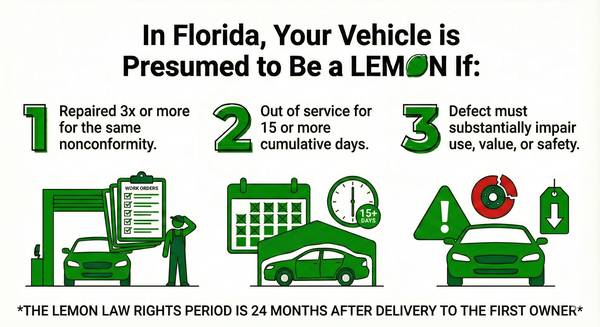
Manufacturers or dealerships must have the chance to repair the nonconformity within a reasonable number of attempts. In Florida, a reasonable chance means at least three repair attempts or that the servicer has held the vehicle for a cumulative total of fifteen days or more.
Chapter 681 defines motor vehicles as "a new vehicle, propelled by power other than muscular power, which is sold in this state to transport persons or property…"
However, it excludes the following vehicle types:
- Motorcycles
- Trucks over 10,000 pounds
- Off-road vehicles
- Vehicles that run only on tracks
- Electric bicycles
- Mopeds
- The living facilities of recreational vehicles
How Does Florida Lemon Law Work?
The remedy process is similar in Florida as in most states. Vehicle owners should first inform the manufacturer or dealership of the issue, allow them to attempt a repair, and then consider more severe options if the problem is not resolved to their satisfaction.
However, there are proper steps and guidelines to follow. Doing everything right deters disputes from the manufacturer.
Step-by-Step Process
Step 1: Identify if Your Vehicle Qualifies
Not all vehicles can qualify as a lemon. The defect must substantially alter the vehicle's use, safety, or value, thereby violating the warranty. This means that problems like a rattling dashboard or static on the radio typically are not enough.
Lemons must also have been purchased or leased within Florida and be used for personal, family, or household purposes. This means that vehicles bought for resale cannot qualify.
Used car owners may want to run a title check through services like GoodCar. Florida does not void Lemon Law protections if the car is sold to another party, as long as the claims deadline hasn't passed. A title check can reveal past, persistent problems or active lemon law claims.
Lastly, some vehicle types are not protected by the Florida Lemon Law. The complete list can be found in the "What is the Lemon Law in Florida?"
Step 2: Provide Written Notice to the Manufacturer
If your vehicle meets the criteria, the next step is to send a written notice of the defect to the manufacturer. "The Consumer Guide to the Florida Lemon Law" provides a template for this notice. Dealerships are required to provide this booklet at the time of purchase; however, you can also download the form here.
Step 3: Cooperate with the Certified Settlement Program
Most manufacturers offer state-certified informal settlement programs. If available, Chapter 681 requires that consumers go through these services before seeking board arbitration.
If the manufacturer does not offer one of these settlement programs, then consumers may proceed directly to arbitration.
These programs are designed to quickly resolve disputes by getting the vehicle to warranty standards. This is where the dealership will take the vehicle in for repairs. If they are unable to bring the lemon up to warranty, then they will proceed with compensation.
Step 4: Seek Arbitration
Consumers who cannot reach an agreement with the manufacturer can proceed to arbitration with Florida's New Motor Vehicle Arbitration Board. The Office of the Attorney General oversees this service, and the application form is available on the government website.
The application for arbitration must be received within 60 days of the expiration of the Lemon Law Rights Period. This period ends 24 months after the lemon is delivered to its first owner.
There are multiple locations across Florida where the board may convene. At these meetings, consumers may present oral disputes and provide evidence. If the arbitration is accepted, the board must hear the dispute within 40 days and render a decision within 60 days.
Step 5: Going to Court
Manufacturers must submit to the Arbitration Board's decision, but consumers can appeal to the circuit court. Appeals must be filed within 30 days of the board's decision.
At this time, it is recommended to consult a specialized Florida Lemon Law attorney. These professionals typically do not charge unless you win your court claim, causing the manufacturer to pay the attorney fees.
Bad Faith Claims
Florida Lemon Law considers the potential for bad faith claims. These are fraudulent attempts by vehicle owners to profit from a damaged vehicle by misrepresenting the timing, severity, or cause of a defect.
If the court determines that a claim was made in bad faith, the consumer will be liable for all costs and reasonable attorney's fees incurred by the manufacturer in the case.
Florida Lemon Law Qualifications
The settlement, arbitration, and legal processes are all used to determine whether your vehicle is a lemon and is eligible for compensation. A lemon in Florida must meet the following requirements:
- Nonconformity violates the manufacturer's written warranty
- Nonconformity substantially impairs the vehicle's use, value, or safety
- Vehicle is primarily used for personal, family, or household purposes
- Nonconformity is reported within 24 months of delivery to the first owner
- Manufacturer or service agent has failed to repair the nonconformity
- Vehicle was purchased or leased within Florida
Violates Warranty
Florida Lemon Law states that the manufacturer's obligation is to make repairs so that the vehicle conforms to the warranty. This means that the defect must infringe on the written warranty or any promise made by the manufacturer; otherwise, it is not protected by Chapter 681.
This responsibility to repair does not extend to promises made by the dealer while attempting to push a sale.
Vehicle Use and Types
The law defines a "consumer" as a purchaser or lessee who obtains a motor vehicle primarily for personal, family, or household purposes. This stipulation means that the Florida Lemon Law does not protect individuals who purchase a car for resale.
Additionally, some vehicle types are not protected, even if they are used for the purposes mentioned above. Motorcycles, mopeds, commercial trucks, and the living sections of recreational vehicles are excluded from Lemon Law claims.
Substantial Nonconformity
A substantial nonconformity is any defect or condition that harms the driver's ability to control the vehicle or could lead to serious bodily harm. A nonconformity does not include issues originating from an accident, owner neglect, or a third-party modification to the vehicle.
Failed Repair Attempts
Florida Lemon Law has two "presumptions" that determine whether the manufacturer has had a fair shot at fixing the nonconformity.
The first presumption is that the consumer has brought the lemon in for repair at least four times for the same issue. After the third attempt, the owner must send the manufacturer a notice for the final opportunity to address the problem.
If the manufacturer does not fix the problem after 10 days of receiving the notice, then they have reasonably failed. The repair period for recreational vehicles extends to 45 days.
The second potential presumption is that the lemon has been in the manufacturer's service facility for at least 30 total days. These days do not have to be consecutive, nor do the repair visits have to be for the same nonconformity each time.
After the fifteenth day, the owner must send the manufacturer a notice of final opportunity to repair, just as in the first presumption. The manufacturer has failed to repair the lemon if it is not brought to warranty standard by the thirtieth cumulative day.
Florida Lemon Law Time Limit
Unlike other states, the Florida Lemon Law filing deadline is not strictly based on the vehicle warranty period.
Instead, Florida sets a "Lemon Law Rights Period" which lasts until 24 months after the dealer delivers the vehicle to its first owner. The manufacturer must receive notice of the nonconformity within this period.
Applications for the mediation and arbitration program must be filed within 60 days of the expiration of the Lemon Law Rights Period. The board does not consider the claim as filed until it is received by them and date-stamped.
These deadlines ensure that owners cannot wait too long to act. Delaying repairs may result in owners missing their opportunity to receive compensation.
Refer to our step-by-step process above to learn how to meet the deadline. →
Compensation and Remedies Under Florida Law
If either the manufacturer or arbitration board declares the vehicle a lemon, the manufacturer must replace it with a vehicle of comparable value or issue a refund. The consumer retains the right to choose the method of compensation.
Both refund and replacement are calculated based on an offset. This means that the value of the compensation considers factors such as the additional mileage incurred before the nonconformity first appeared. The offset cannot include mileage incurred from any repair attempts, so maintaining a strong record of the odometer is essential.
Lemon Law requires that a replacement motor vehicle be identical or reasonably equivalent to the original vehicle at the time of purchase. The replacement cannot be worth more than 105 percent of the original vehicle's value.
Refunds are paid to the consumer based on the non-financed charges, as the financed portion is paid directly to the lender by the manufacturer. However, the manufacturer does pay the owner for reasonably incurred collateral charges, such as service charges, sales taxes, and title charges.
Why Work with a Florida Lemon Law Attorney

Many consumers choose to hire an attorney because purchasing a vehicle is such a significant investment. Manufacturers often have legal teams who know how to pressure individual consumers into backing down.
A Florida Lemon Law attorney is familiar with warranty law and the state's specialized arbitration process. They can make sure notices are properly delivered, repair attempts are properly documented, and manufacturers follow through on their obligations.
If you disagree with the arbitration board's decision, then an attorney can make your claim as strong as possible before the court.
Lemon Law requires that the manufacturer pay the consumer's attorney's fees in a successful case. And most Lemon Law attorneys do not charge unless you win, so consumers typically do not pay out of pocket.
FAQ
Florida does not revoke protections after a sale. Used vehicles are covered as long as they are still within the Lemon Law Rights Period, which is 24 months after the vehicle is delivered to its first owner.
Consumers must send a Defect Notification Form to the manufacturer within 24 months of the vehicle's delivery.
Yes. Consumers can only sue the manufacturer after seeking relief with the manufacturer's dispute settlement program (if available) and then the Florida New Motor Vehicle Arbitration Board.
A substantial defect impacts the driver's ability to control the vehicle or any issue that could lead to serious bodily injury. For example, brake failure can lead to crashes, whereas an exterior scratch poses a low risk.
Vehicle owners with a lemon can be compensated through a refund or a comparable replacement. Consumers are allowed to choose the method.
Yes, Lemon Law attorneys typically work on a contingency basis, meaning they are only paid if they win the case for you. In successful claims, manufacturers must pay reasonable attorney's fees, so the consumer's risk is low to none.
No. Florida Lemon Law excludes motorcycles, mopeds, and other non-conventional vehicles. Recreational vehicles are covered, but only the non-living space areas are covered. So, bathrooms, living rooms, and kitchen areas in a mobile home are not protected.
Florida Resources


FREE Vehicle Search
- Accidents
- Problem Checks
- Title Records
- Recalls
- Values
- Specs


-
 InfoPay, Inc. (dba GoodCar) is an Approved NMVTIS Data Provider
-

-
