


Georgia Lemon Law

Vehicles that suffer from repeated defects are often called “lemons,” due to the sour taste they leave in the owner’s mouth. Repairing a car is expensive, and too many problems will quickly make the effort more trouble than it’s worth.
Fortunately, each state maintains consumer protection laws that help people in this position pursue compensation. These Lemon Laws typically take effect after the manufacturer fails to fix the issue after a few attempts or if the vehicle is held in service for an extended period.
Georgia is among the few states to offer a formal, state-run arbitration process. This no-cost program guides consumers through the process, ensuring that manufacturers fulfill their obligations in a fair and timely manner.
What Is the Lemon Law in Georgia?
Georgia’s Lemon Law is managed by the state’s Attorney General’s Consumer Protection Division. The law protects consumers by requiring manufacturers to either repair, replace, or repurchase vehicles with serious, recurring defects.
However, not all vehicles qualify. Georgia only protects new vehicles purchased or leased within the state. The law applies to vehicles acquired for personal, family, or household use. Most vehicles obtained for other purposes, such as resale, are excluded.
Georgia’s Lemon Law also omits the following vehicle types:
- Motorcycles
- Mopeds
- All-terrain vehicles
- Boats
- Towed vehicles (trailers, campers, etc.)
Vehicle owners must act within their rights period, which lasts for two years after delivery or the first 24,000 miles. The manufacturer must have “reasonable opportunity” to fix the issue within this rights period.
Once the manufacturer fails to bring the vehicle back to warranty standards, they must compensate the owner. If they don’t, or if the compensation is lacking, then the owner has up to one year after the rights period ends to seek arbitration from the state.
How Does Georgia’s Lemon Law Work?
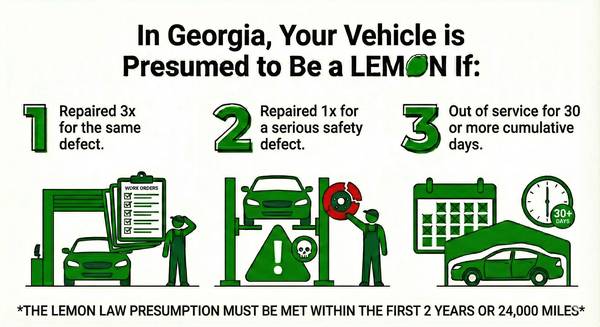
Consumers must adhere to specific steps and deadlines before sending a claim to Georgia’s arbitration board.
Owners must first determine whether their vehicle qualifies as a lemon. This step involves determining whether the defect breaches the warranty or significantly damages the vehicle’s safety, use, or value.
Afterwards, the manufacturer must have a reasonable chance to address the defect before offering compensation. Georgia defines a reasonable chance based on the time the vehicle is out of service or the severity of the issue.
Once the manufacturer has failed in their repair attempts, the consumer may submit a request for compensation or arbitration. Consumers must report repair attempts and submit requests in a timely manner to remain valid under Georgia law.
Below is a more detailed breakdown of the process to ensure you meet all the requirements for compensation.
Step-by-Step Process
Step 1: Confirm the Vehicle Type and Defect
The Georgia Lemon Law only protects new vehicles purchased or leased within the state. The law primarily applies to personal vehicles, but it can also cover businesses that purchase or lease fewer than ten vehicles per year.
Additionally, only certain vehicle types can be lemons. Four-wheeled vehicles, including passenger cars, SUVs, vans, and lightweight trucks, are covered. However, specialized vehicle types, such as ATVs, boats, and motorcycles, are excluded.
The vehicle must also have a substantial defect. Minor issues, such as a squeaky door, are not enough to invoke Georgia’s lemon law. Most valid lemons have defects that endanger the driver, affect vehicle control, or severely decrease its value.
Step 2: Bring the Vehicle in for Repairs
Georgia law requires that manufacturers get a reasonable number of attempts to fix the defect. The law has three methods for determining whether they’ve gotten a fair chance. These conditions must be met within the lemon rights period (two years following delivery or 24,000 miles).
The first condition is fulfilled if the same defect persists after three or more repair attempts have been made. It is essential that you inform the facility, in writing, of any warranty defects you wish to have fixed prior to the first repair attempt. Doing so creates proof that every attempt was for the same issue.
The second condition reduces the manufacturer’s allowed repair attempts from three to one. In these cases, the warranty defect must be life-threatening or likely to result in bodily harm. Georgia’s Attorney General’s Office (404-458-3827) can help determine whether a defect meets this requirement.
The third condition is met if the vehicle is held in repair for a total of thirty days or more. These days must be related to a lemon-level defect, but do not have to be consecutive. This time limit ensures that repair facilities do not hold vehicles indefinitely for individual repair attempts.
Repair attempts or time out of service must occur at a manufacturer or authorized dealer’s service facility. Any sessions performed by a third party will not be counted toward the total and may void the warranty.
The repair facility is legally required to provide a repair receipt after each attempt. These receipts show what they worked on and the date of each repair. This information enables you to demonstrate that the vehicle meets one of the above conditions for lemon status.
Step 3: Send a Final Notice for Repair
The manufacturer is allowed a “final” chance to fix the problem. This final chance only occurs if you send an official notice to the manufacturer. Georgia provides a printable form, or you may draft a custom letter, including the following information:
- Your address and phone number
- Vehicle information (year, make, model, and VIN)
- Vehicle’s current odometer reading
- Vehicle’s original delivery date
- Dealership’s name and contact information
- Defect causing lemon status
- Repair facility information (include all facilities that performed repairs)
- Repair dates and what defects persisted after each attempt
This notice letter must be sent via overnight mail or through a return receipt certified mail carrier. The manufacturer’s address can be found in your owner’s manual, but you can also request the information from the dealership. Make sure to save any proof of delivery.
Upon receiving the notice, the manufacturer has seven days to refer you to a repair facility for the final repair. This facility must be reasonably accessible, meaning within sixty miles of your residence.
If the manufacturer does not provide a repair facility within seven days, they automatically fail the final repair attempt.
The referred repair facility has fourteen days to perform a final repair that restores the vehicle to warranty standards. This time limit starts on the date you deliver your vehicle to them.
Step 4: Request Compensation
If the manufacturer cannot repair the defect after the final attempt, Georgia’s Lemon Law entitles you to a refund or a comparable replacement vehicle. The consumer always has the right to choose their preferred remedy.
In a refund, the dealership is purchasing the vehicle back from you. They are required to purchase the vehicle at its full purchase price, including collateral costs such as sales tax, dealer charges, extended warranty fees, and any interest incurred from a loan.
Some people opt for a replacement vehicle, allowing them to quickly return to normalcy rather than going through the auto shopping process again. A replacement vehicle should be at least equivalent in value to the original vehicle. The manufacturer also reimburses you for collateral costs attributable to the lemon claims process.
You can use the Vehicle Repurchase or Replacement Request form and send it to the manufacturer's address found in your owner’s manual. This letter must be sent via overnight delivery or with return receipt service. Keep a copy of the delivery confirmation for your records.
The manufacturer has twenty days to respond after receiving the request. This response may include offers for alternative remedies such as additional repairs or “cash and keep.”
Step 5: Applying for Arbitration
The Georgia Attorney General’s Office offers the only certified arbitration process in the state. This program allows both parties (manufacturer and consumer) to report their situation to the arbitration board for a final decision.
You must submit an application form to the Attorney General’s Consumer Protection Division. The form is only available by calling and requesting at 404-458-3827. It is recommended that you attach copies of the repair receipt and any relevant communications with the manufacturer.
This form must be submitted within one year of the expiration of your lemon rights period.
The arbitration board reviews the evidence and schedules a hearing within forty days of accepting the case. The hearing is held in a location within 120 miles of your residence.
The board’s judgment is not always final and can be appealed by either party. However, the decision is admissible in eventual court hearings.
Manufacturers have up to forty days to comply or appeal the board’s decision. Consumers have up to thirty days to appeal the board’s decision in superior court.
Qualifications for Georgia’s Lemon Law

Lemon laws protect the consumer, but can be easily abused without strict qualifications. Georgia sets the following conditions for vehicles under their lemon law:
- The vehicle must be new and purchased or leased in Georgia
- The vehicle title remains in the name of the original purchaser
- The vehicle is of a qualifying vehicle type
- The vehicle must have a defect that substantially impairs use, value, or safety
- Manufacturers must have a reasonable chance at repair within the rights period
Consumer Requirements
The Georgia Lemon Law only applies to vehicles purchased, leased, or registered in Georgia. The owner does not need to be a resident of Georgia.
Individuals must use the vehicle for personal, household, or family purposes. Vehicles purchased for reselling or leasing to another party are not protected. Businesses may benefit from lemon law protections if they obtain ten or fewer vehicles per year.
Vehicle Types
Georgia defines “new motor vehicles” as any self-propelled vehicle meant to transport people or property over public highways. Most conventional personal vehicles, such as passenger cars, vans, SUVs, and lightweight trucks, are covered in Georgia.
The exempted vehicle types include:
- Trucks with more than 12,000 pounds gross vehicle weight rating
- Motorcycles
- Golf carts
- Boats
- ATVs
The title must remain in the original owner’s name, and no transfer documents indicating a used status must be attached.
Substantial Defect
A substantial defect must severely affect the vehicle’s performance, value, or safety. Generally, this term refers to any issue that prevents someone from using the vehicle in a reasonably expected manner.
For example, a scratch on the side mirror does not significantly impact a reasonable person’s experience with a vehicle. However, a stuck steering wheel or unreliable braking system would make them scared to drive.
Georgia’s lemon law separately defines a serious safety defect as a “life-threatening defect or a malfunction that impedes the consumer’s ability to control or operate the motor vehicle…or creates a risk of fire or explosion.”
Failed Repair Attempts
Lemons must have gone through a reasonable number of repair attempts by the manufacturer or their agents. This requirement protects sellers by preventing consumers from automatically qualifying for a refund.
Georgia’s lemon law states that manufacturers have failed to reasonably repair the defect if any of the following conditions are met:
- The same defect persists after a minimum of three repair attempts
- A serious safety defect persists after one repair attempt
- The vehicle has been out of service for a total of thirty days due to any substantial defect
Repairs or out-of-service time must occur in a manufacturer-related service facility. Attempts made at a third-party shop will not count toward the above conditions.
Once any of these conditions are true, you must send a final notice of repair to the manufacturer. This letter indicates that their facility has one last chance, or fourteen days, to rectify the defect or provide compensation.
It is essential that you send this letter as soon as possible. You cannot request compensation until you have sent the final notice and allowed the final repair attempt. All repair attempts must occur within the lemon rights period.
Time Limits and Notice Deadlines
Georgia’s Lemon Law has two key time limits.
First, the Lemon Law rights period. This period lasts for two years after the vehicle’s original delivery or 24,000 driven miles, whichever occurs first. All of the manufacturer’s repair attempts, up to their final attempt, must occur within this time limit. However, any ongoing repair that occurs while the rights period expires will still be counted.
Second, consumers have up to a year after the rights period expires to file for arbitration with the Attorney General’s Office. Arbitration is your last chance to enforce compensation without going through the headache of court.
Missing these deadlines can cause your case to be dismissed, regardless of the defect’s severity and damage to your life.
Compensation and Remedies Under Georgia Law
Manufacturers primarily offer compensation through refund or replacement. Georgia’s lemon law sets clear guidelines on minimum compensation. Understanding these rules ensures that you do not accept a subpar remedy.
Refunds
The dealership can repurchase the lemon at the full purchase price, which is the price stated in the original sales agreement. The full purchase price also includes any reasonable allowance for trade-in vehicles.
Refunds cover incidental costs, including sales tax, registration fees, temporary transportation costs, towing, and loan interest payments. You can potentially argue for further additions, but they must be directly attributable to the lemon’s defect.
A reasonable allowance for use can also decrease a refund. This factor is calculated based on mileage incurred outside of repairs. Therefore, any miles accrued by the repair facility on the vehicle will not be counted toward this decrease.
Replacement Vehicles
The manufacturer can offer to replace the lemon with a vehicle of comparable value. This deal typically involves replacing the lemon with a vehicle of the same make, model, and additional features.
Unlike in a refund, the replacement vehicle’s value is not affected by the lemon’s reasonable allowance for use. So, it does not matter how many miles are on the lemon. The manufacturer must also pay for collateral costs, such as registration and towing.
In some cases, you may not want a replacement vehicle from the manufacturer due to a loss of trust. You cannot be compelled to accept a replacement if you prefer a refund.
Alternative Remedies
The manufacturer may offer other remedies based on the situation. They can offer additional repair attempts, extended warranties, or vehicle upgrades. These are often appealing if the lemon’s defect is not a dealbreaker.
Another popular option is a cash-and-keep offer. This term refers to a cash settlement, in which you retain the lemon but are paid a certain amount to compensate for the vehicle’s reduced value.
Why Work with a Georgia Lemon Law Attorney

Georgia’s arbitration system is different from most state-certified programs. It allows the manufacturer to appeal the board’s decision, meaning that the consumer may be forced into court if they want compensation.
A lemon law specialist is a consumer-friendly way to protect yourself from this situation. Manufacturers are far less likely to appeal in court if they know that you have a lemon law specialist.
Most Georgia Lemon Law attorneys work on a contingency basis, meaning they only get paid if you win. If successful, the manufacturer is responsible for paying your attorney’s fees, not you. This structure enables consumers to assert their rights without incurring the cost of representation.
An experienced Lemon Law lawyer understands the nuances of Georgia’s lemon law and determines whether you have a case. These professionals can manage your documents, deadlines, and communications with the manufacturer to maximize your payout.
FAQ
No. Georgia’s Lemon Law only applies to new vehicles purchased or leased in the state. The title must be in the original owner’s name to qualify.
A substantial defect is one that significantly impairs the vehicle’s use, safety, or market value. A serious safety defect refers to life-threatening issues like faulty brakes or “defects that may cause fire and explosions.”
You may only file for arbitration after the manufacturer fails to repair the defect within a reasonable timeframe. These repairs must be made within two years of the vehicle’s delivery date or 24,000 miles driven. You then have up to one year to file a claim.
No. Georgia does not require consumers to complete the state-certified arbitration before filing a lawsuit.
Georgia requires manufacturers to pay consumers’ attorney fees in a successful case. Regardless, most lemon law attorneys do not charge their clients if they lose.
Yes. Leased vehicles qualify if they are covered by the original warranty and owned by the original title holder.
Georgia Resources



FREE Vehicle Search
- Accidents
- Problem Checks
- Title Records
- Recalls
- Values
- Specs


-
 InfoPay, Inc. (dba GoodCar) is an Approved NMVTIS Data Provider
-

-
